Retrofitting Old Glass Neon to LED Flex: What Transfers and What Does Not
- 2026-10-28 10:02
- /
- Arraystar LED
Clients love the retrofit price, but swapping glass neon for LED flex is not a like-for-like job. The transformer comes out, the mounting depth changes, and the viewing distance the sign was designed for stops being right.
What actually transfers
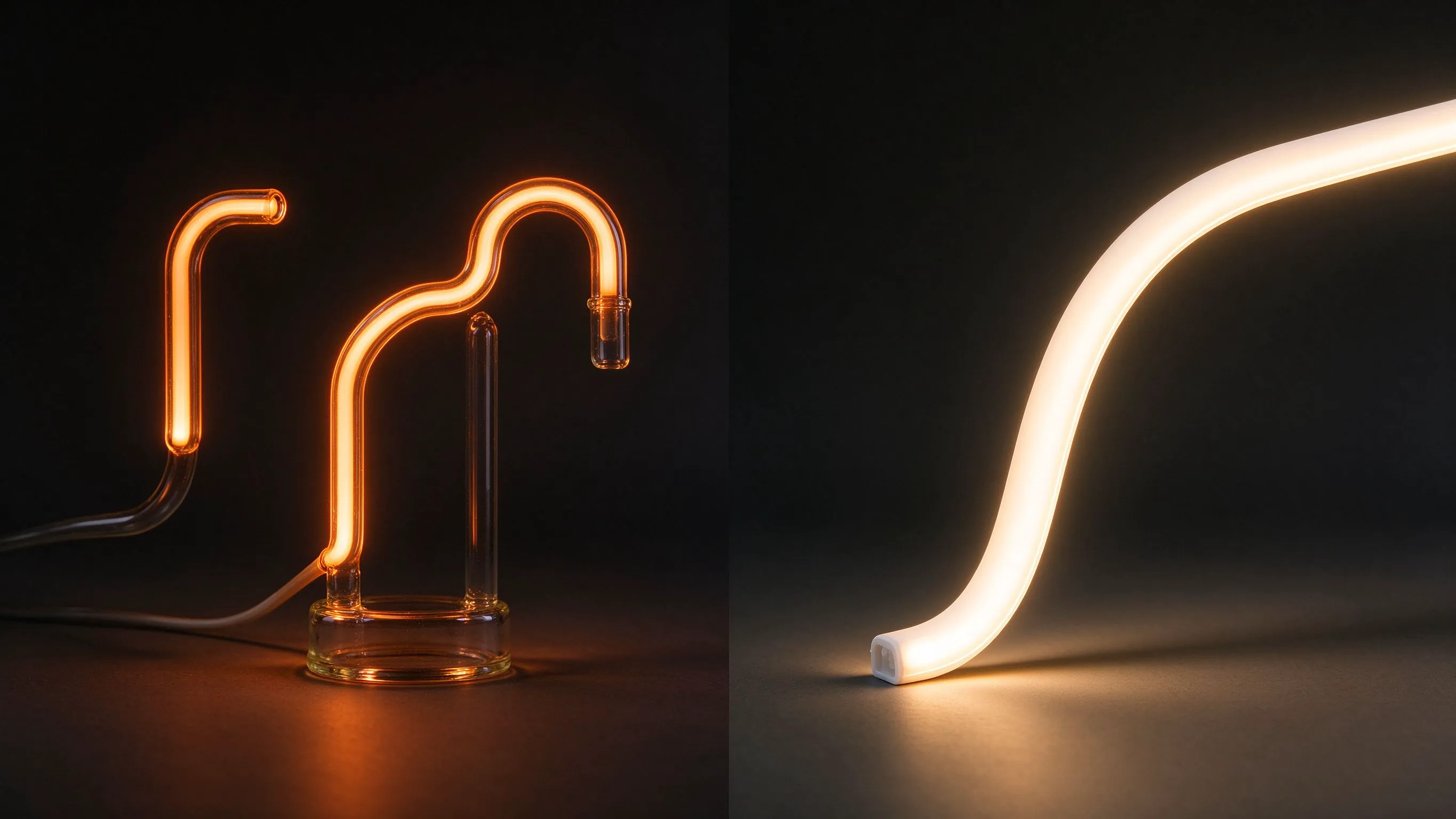
The outline of the letter transfers. The voltage on the wall does not. The old glass sign ran on a high-voltage transformer (typically 5 to 15 kV) at milliamps; LED flex runs on 12 or 24 V DC at amps. You cannot reuse that transformer, and you should not want to, those old units are noisy, leaky, and a fire risk after 20 years.
What also transfers is the mounting pattern. If the old tubes hung on standoffs, you can reuse the standoff holes in most cases, because silicone flex diameters (8 to 16 mm) sit inside the range of old glass diameters (10 to 20 mm). That is where the saving comes from.
What does not transfer

The viewing distance does not transfer. Glass neon was a continuous glowing line; LED flex, even at high density, is a row of LEDs seen through a diffuser. Up close, you can see the dots. From the pavement at 10 metres, you cannot. If the old sign was designed for a 3-metre viewing distance (a shop window), the new flex will look dotted in a way the glass never did.
The brightness balance also changes. Glass neon was very bright on the tube and dark around it. LED flex is brighter overall but washes more onto the back panel. I usually increase the standoff gap by 5 to 10 mm compared with the old glass job.
- Throw away the old HV transformer.
- Reuse standoff holes only if the diameter matches.
- Expect to re-paint or re-finish the back panel; flex throws more spill.
- Add a 12/24 V driver in a vented box.
Wiring and driver sizing

Glass neon drew almost no current; LED flex draws real amps. A five-metre run at 12 V can pull 8 to 10 A, which means 2.5 mm squared (about 13 AWG) feed cable, not the thin signal wire left over from the old transformer. I size the feed so voltage drop over the run stays under 3 percent; at 12 V that is about 0.36 V, which usually limits a single feed to 3 to 4 metres before you need a second feed point.
24 V nearly doubles the run length; dual feed splits the drop.
| Voltage | Practical max single-feed run | Feed cable size |
|---|---|---|
| 12 V | 3-4 m | 2.5 mm2 (13 AWG) |
| 24 V | 6-8 m | 1.5 mm2 (16 AWG) |
| 24 V + dual feed | 12-15 m | 1.5 mm2 each leg |
I prefer 24 V for retrofits because the lower current lets me reuse the existing conduit without upgrading every wire.
Mounting depth and optics

Old glass tubes sat about 20 to 30 mm off the panel. LED flex at that gap looks fine, but the back panel picks up a warm wash that the glass never produced. I open the gap to 25 to 35 mm and, on light panels, add a black backing strip behind the run. The outline stays crisp and the panel stays dark.
For close-up viewing (window signs, 1 to 3 metres), I move to a higher-density flex with a diffused jacket so the dots disappear. For rooftop or roadside (10+ metres), a standard-density tube is plenty and cheaper.
The handover reality check
Before I quote a retrofit, I stand where the sign's audience stands. If the sign is read from a moving car at 20 metres, flex is a straight swap and the client saves on the transformer. If it is read from a queue at the door, I tell them up front that the old glass look was smoother and they might prefer a higher-density tube or even a dedicated neon-style channel.
- Remove the HV transformer and dispose of it as e-waste.
- Run a 12/24 V feed in the existing conduit if it is in good shape.
- Open the standoff gap by 5 to 10 mm compared with glass.
- Match tube density to the real viewing distance.
Recommended Products
Frequently Asked Questions
Can I reuse the old glass neon transformer for LED flex?
No. Old glass transformers put out 5 to 15 kV at milliamps; LED flex wants 12 or 24 V DC at amps. The two are not compatible, and those old units are often leaky and unsafe after decades. Remove it and fit a modern 12/24 V LED driver in a ventilated box.
Does LED flex look the same as old glass neon?
From 10 metres, yes, a clean glowing line. Up close, flex is a row of LEDs behind a diffuser, so you may see dots on window signs read at 1 to 3 metres. For close work I spec a higher-density tube with a frosted jacket; for roadside or rooftop, standard density is fine.
Can I reuse the existing standoff holes?
Often yes. Silicone flex diameters (8 to 16 mm) sit inside old glass diameters (10 to 20 mm), so the old holes usually line up. I check the wall plug is still sound, and I open the standoff gap by 5 to 10 mm because flex throws more spill than glass.
What voltage should I use on a retrofit?
Prefer 24 V. The lower current lets you run 6 to 8 metres on a single feed in 1.5 mm squared cable, often reusing the existing conduit. At 12 V you are limited to 3 to 4 metres before voltage drop becomes visible. For runs over 8 metres, dual feed from both ends.
Why does my retrofit look brighter than the old glass sign?
LED flex puts out more light overall and spills more onto the back panel. Open the standoff gap to 25 to 35 mm, add a black backing strip on light panels, and if it is still too bright, dim the driver to 80 to 90 percent rather than swapping the tube.
Need help with your LED project?
Get factory-direct pricing, free samples and engineering support within 24 hours.
Email: info@arraystarled.com | Phone: +86-0755-2103-6746 | WhatsApp: 0086 1581 8514 077
Need to size your power supply? Use our LED Strip Power Calculator to find the right driver in seconds.