Neon Sign Vibration on Rooftops: Strain Relief That Actually Holds
- 2026-10-28 10:02
- /
- Arraystar LED
Rooftop neon flexes in the wind, and the break is almost never in the tube body. It is at the wire exit, where a million tiny bends fatigue the copper until one morning the sign is dark. The fix is a proper service loop that absorbs the movement, not a tighter clamp.
Where rooftop neon actually breaks
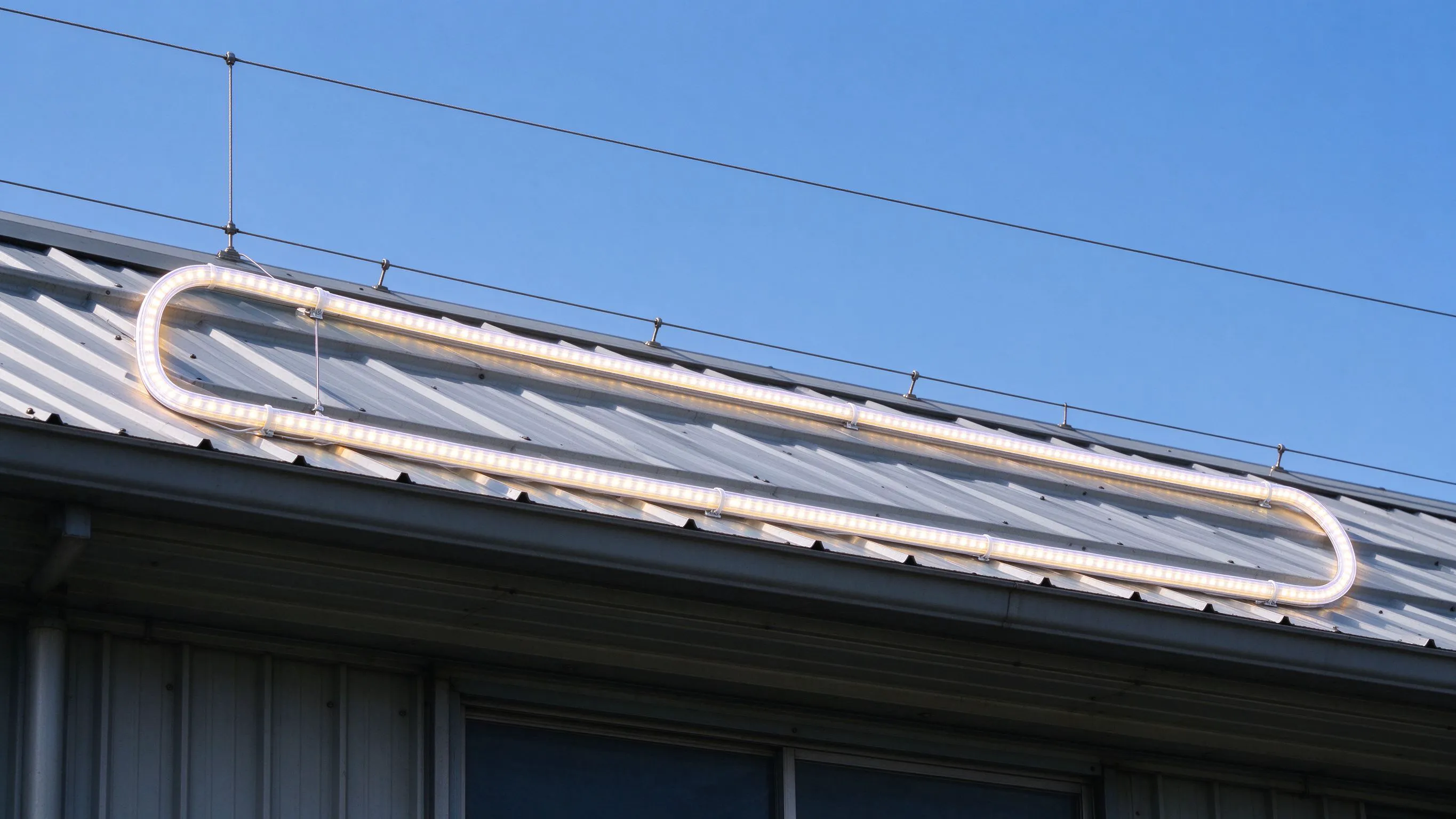
A rooftop sign in a high wind is a small lever arm. The tube and channel sway, the standoffs stay fixed, and every oscillation lands at the point where the power cable leaves the end cap. The copper wires inside that cable flex a few degrees each time the wind gusts. Over a season that is millions of cycles, and the wire snaps at the solder heel inside the gland. The tube itself is usually perfect; you just cannot power it.
I have climbed onto roofs where the fixer had clamped the cable dead tight at the gland, thinking a firm grip would hold it. That is the worst thing you can do, because now the wire has no slack and the flex concentrates exactly at the clamp. The cable wants a loop, not a strangle.
The failure pattern I look for
- Dark sign, good tube: check the wire exit first.
- No movement at the gland means the wire fatigues at the clamp.
- A service loop lets the sway bend the slack cable, not the solder.

The service loop that actually holds
My rule is to leave a 100 to 150 mm loop of cable between the last standoff and the wall or parapet gland, and to strain-relieve the cable inside the junction box rather than at the gland. When the tube sways, the loop flexes gently. The solder joint at the tube end barely moves because the slack cable absorbs the motion. Tight, clamped, straight cable is what cracks; a loose loop is what survives ten winters.
More wind means more slack loop and closer standoffs, not a tighter clamp.
| Wind exposure | Loop length | Standoff spacing | Check frequency |
|---|---|---|---|
| Sheltered rooftop | 100 mm | 400 mm | Every 2 years |
| Exposed parapet | 150 mm | 300 mm | Every year |
| Open coastal roof | 200 mm | 250 mm | Every 6 months |
I also shorten the standoff spacing on exposed roofs. Closer clips mean the tube has less free length to whip, which lowers the stress at the cable exit in the first place. A rigid, well-supported run flexes far less than a long, floppy one.
Cable choice and gland type
On a vibrating roof I use a flexible, multi-strand low-voltage cable, never a solid-core wire, because solid copper fatigues fast under repeated bending. The gland is a double-compression type that grips the outer sheath but leaves the inner copper free, and I bed it with neutral-cure silicone so water cannot track down the cable into the junction box. Heat-shrink with adhesive liner seals any inline joint inside the conduit; tape is forbidden up there.

Mechanical stiffening of the run
The cheapest vibration fix is to stop the run moving. I back long horizontal runs with an aluminium extrusion channel, which turns a floppy silicone strip into a rigid beam that barely sways in the wind. On parapet-mounted signs I also tie the channel into the parapet at mid-points, so the whole assembly moves as one rigid object rather than whipping like a rope.
- Back the run with an aluminium channel to turn flex into a rigid beam.
- Tie the channel to the parapet at mid-points so it moves as one piece.
- Use multi-strand cable only; solid core fatigues under repeated bend.
The six-month rooftop check
After every storm season I ask to go back up and look at the service loops. I give each cable a gentle wiggle, check the glands for tightness, and feel whether any standoff has started to rotate. A loose clip on a vibrating roof is the start of a fatigue failure, and catching it in ten minutes avoids a call-out when the sign goes dark at peak trading night.

Recommended Products
Frequently Asked Questions
Why does my rooftop neon sign go dark in winter?
Almost always a fatigued wire at the cable exit. The wind flexes the run, the copper at the solder heel breaks after thousands of tiny bends, and the sign dies overnight. The tube body is usually fine. Fit a 100 to 150 mm service loop between the last standoff and the gland so the slack cable absorbs the sway, not the solder joint.
Should I clamp the cable tight at the rooftop gland?
No, and it is the most common mistake. A tight clamp removes all slack, so every gust bends the wire at the clamp itself, which fatigues fast. Leave a loop of flexible multi-strand cable and strain-relieve it inside the junction box. The loop flexes; the solder joint stays still. Tight grips cause the failure they are meant to prevent.
How often should standoffs be spaced on a windy roof?
Closer than you would use on a wall. On an exposed parapet I hold standoffs at 300 mm centres, and on an open coastal roof I drop to 250 mm. Close clips give the tube less free length to whip, which lowers stress at the cable exit. Long, floppy runs are what fatigue; rigid, well-supported runs flex very little.
Does backing the neon with an aluminium channel help?
Yes, a lot. A silicone strip alone is floppy in the wind, but the same tube set into an aluminium extrusion becomes a rigid beam that barely sways. Tie the channel to the parapet at mid-points so the whole assembly moves as one piece. Stiffening the run is the cheapest vibration fix there is, because it removes the flex at source.
Solid core or stranded cable for a vibrating roof?
Multi-strand flexible cable, always. Solid copper wire fatigues and snaps under repeated bending within a season of wind gusts, while stranded cable flexes hundreds of thousands of times without breaking. Pair it with a double-compression gland that grips the sheath but leaves the inner copper free to move.
Need help with your LED project?
Get factory-direct pricing, free samples and engineering support within 24 hours.
Email: info@arraystarled.com | Phone: +86-0755-2103-6746 | WhatsApp: 0086 1581 8514 077
Need to size your power supply? Use our LED Strip Power Calculator to find the right driver in seconds.