
Why Some Neon Tubes Yellow and Others Don't: The PET Film Difference
- 2026-10-09 18:39
- /
- Arraystar LED
A neon sleeve that turns yellow after one summer is almost always a cheap PVC or low-grade silicone diffuser, not a UV problem you can fix. I specify tubes with a built-in PET light-guide film for any sign that sees daylight, because that inner film is what keeps the face clear and evenly lit for years instead of months.
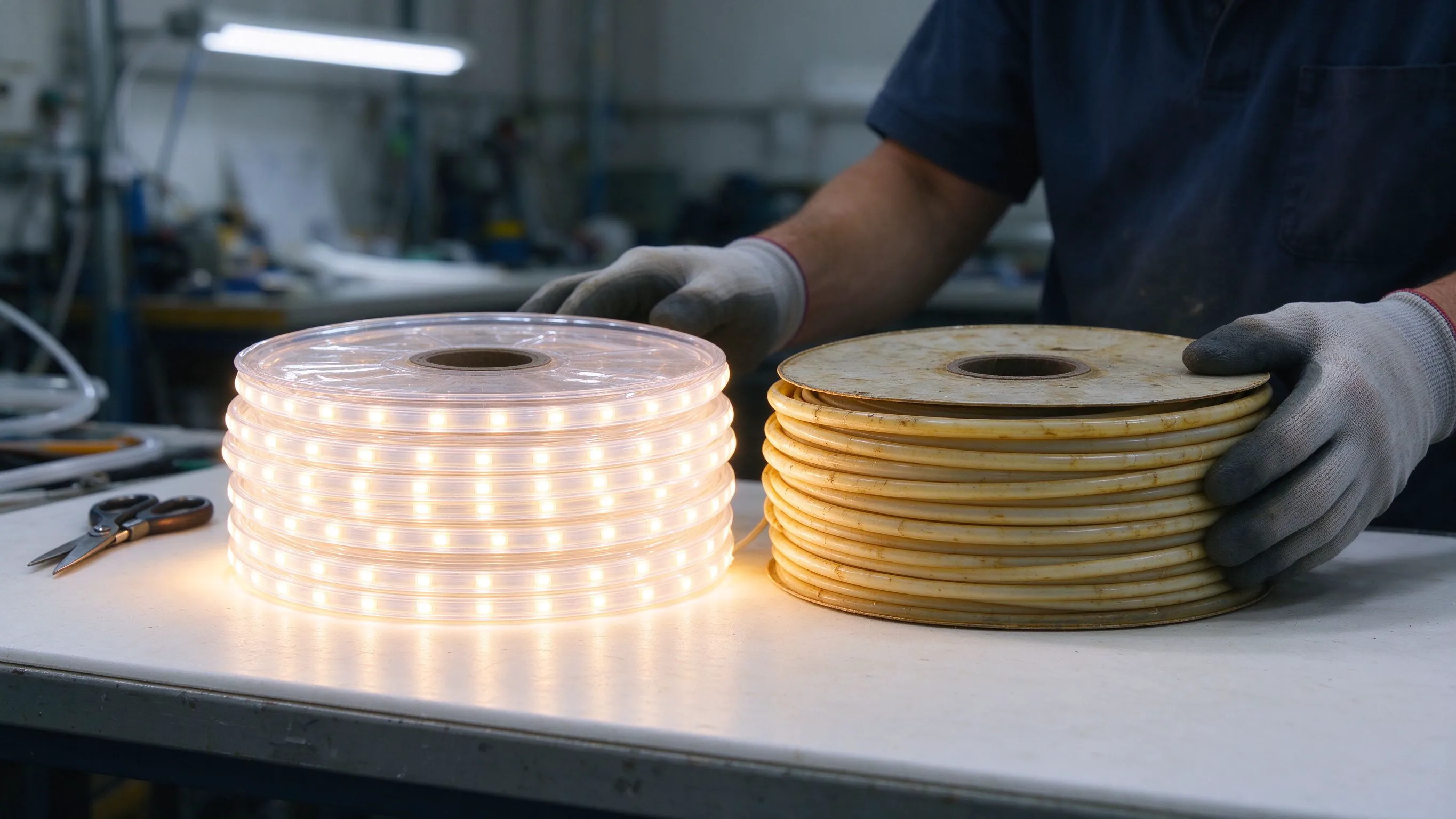
The Yellowing Call I Get Every Spring
Every spring the same phone call comes in: a storefront sign installed eight or ten months ago has started to look cream-coloured, then faintly brown, right across the top edge that catches the afternoon sun. The LEDs are fine. The silicone sleeve has degraded. Once that happens there is no cleaning or polishing that brings it back, because the discolouration is inside the material, not on the surface.
When I cut a yellowed sleeve open I usually find one of two things. It is either PVC, which is cheap and glass-clear on day one but chalks and yellows fast under UV, or it is a low-durometer silicone loaded with filler to cut cost. Both look identical to a clear premium tube on the day you take the sample. The difference only shows up after weathering.
For outdoor and sun-facing indoor work I stopped gambling on bare silicone years ago. I now ask for a neon tube with a built-in PET light-guide film, and it has removed the yellowing complaint almost entirely.
What the PET Film Actually Does Inside the Tube
A PET-film neon tube is still a silicone body, so you keep the flexibility, the waterproofing and the soft diffusing surface. The difference is a thin polyester film formed into a light-guide channel that sits inside the silicone, directly around the LED strip.
- UV barrier. The PET film absorbs and redirects a share of the UV energy that would otherwise attack the outer silicone, slowing the chain reaction that causes yellowing.
- Better light mixing. The film acts as a light guide, spreading the chip light sideways before it reaches the milky silicone. You get a more even face with fewer hot spots at lower LED density.
- A stable optical surface. PET holds its clarity and does not chalk the way PVC does, so the colour temperature the client approved stays the colour temperature they get in year three.
It is not magic armour. A PET-film tube left flat on a rooftop in Dubai will still age faster than one in a shaded mall, and the silicone grade underneath still matters. But in side-by-side weathering, the film-lined tubes I have pulled down after two or three years are visibly clearer than unlined budget sleeves installed at the same time.
PET Film vs Plain Silicone vs PVC: What I Specify
My field shorthand for matching a neon sleeve to the job.
| Tube type | Day-one look | UV / yellowing resistance | Where I use it |
|---|---|---|---|
| PVC sleeve | Very clear, glossy | Poor; chalks and yellows in months | Indoor, short-rental, temporary builds only |
| Plain budget silicone | Slightly milky | Fair; yellows in strong sun over 1-2 years | Indoor signs, shaded outdoor, budget work |
| Premium silicone, no film | Milky, soft | Good with proper UV-stable grade | General outdoor where cost is controlled |
| PET-film silicone tube | Milky and even | Best; stays clear longest in daylight | Sun-facing facades, rooftop signs, premium brands |
How to Verify a PET-Film Tube Before You Buy a Reel
Suppliers can claim anything on a quotation, so I check the physical part rather than trust the label.
The four checks I run on a sample
- Slice it. Cut a 2 cm cross-section. A PET-film tube shows a distinct inner channel or laminated layer you can see and sometimes peel at the cut end. A plain tube is homogeneous silicone all the way through.
- Bend it. The inner film should flex with the body without wrinkling, delaminating or turning white at the crease.
- Light it. Run strip through it and compare the face against a plain tube at the same LED density. The filmed tube should look smoother with less visible chip spacing.
- Ask for the weathering data. A factory that genuinely moulds with PET film can show UV-aging or yellowing-index (Delta-b / YI) test results rather than just saying 'outdoor use'.
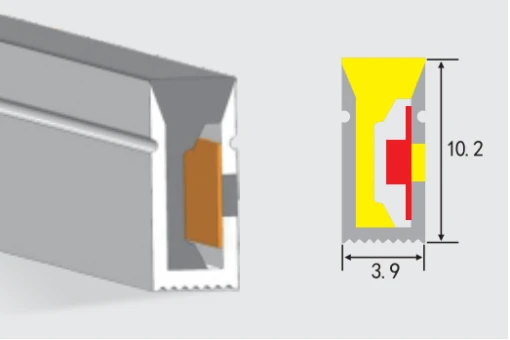
The tube I keep coming back to for this is the PET-sheet ART-NT0410 profile. The inner film is visible at the cut, it flexes cleanly around bends, and it is sized to suit the smaller channel-letter and outline work that makes up a lot of sign-shop volume. Ordering a five-metre sample and doing the slice-and-light test costs almost nothing and tells you more than a datasheet.
Where the Extra Cost Pays Off (and Where It Doesn't)
I do not put a premium PET-film tube on every job. That wastes margin and the client does not need it. I match the sleeve to the exposure the sign will actually live with.
- Spend the money: rooftop and fascia signs facing south or west, coastal installs with strong reflected UV, brand-store rollouts where replacement means travel and downtime, and any sign specified for a five-year-plus life.
- Standard silicone is fine: shaded under-canopy letters, indoor mall stores, north-facing walls and trade-show builds that come down after a season.
- Avoid PVC entirely outdoors: the few cents per metre saved disappears the first time you have to re-sleeve a sign under warranty.
Installation Habits That Protect the Sleeve
Even the best tube yellows early if it is installed badly. Heat accelerates every degradation process, so the sleeve is only as good as the thermal design around it.
- Do not overdrive the strip. Running LEDs above rated current pushes heat straight into the silicone and cooks it from the inside.
- Give the neon room to breathe inside metal channel letters; do not glue it into a sealed, unvented pocket against a hot backing.
- Use the manufacturer's adhesive and clips rather than wrapping the tube in tape, which traps heat and can chemically mark the silicone.
- Keep cut ends sealed on outdoor work so water and pollutants cannot wick under the film.
What to Put on the Purchase Order
When I send an enquiry for outdoor neon I do not write 'clear tube' and hope. I name the construction so there is no ambiguity on the factory floor: silicone body with built-in PET light-guide film, UV-stable grade, outdoor rated, matched to the strip width and IP requirement. I also request a cross-section photo of the actual production part before mass extrusion.
A reputable manufacturer will confirm the film construction, the silicone grade and the expected outdoor warranty in writing. If they cannot tell you whether the tube is PVC, plain silicone or PET-filmed, that alone tells you to keep looking. We have produced all three grades since 2010, and the easiest way to decide is to ask for a free sample of each, slice them on your bench and light them side by side.
Recommended Products
Frequently Asked Questions
Can I stop a neon tube from yellowing once it has started?
No. Yellowing from UV and heat is a chemical change inside the PVC or silicone, so surface cleaners and polishes will not reverse it. The lasting fix is to replace the sleeve with a UV-stable PET-film silicone tube and address any overheating that sped up the degradation.
Is PET film the same as the PVC tube I can buy cheaply?
No. PVC is a single plastic sleeve that is glass-clear when new but chalks and yellows quickly in sunlight. A PET-film neon tube uses a flexible silicone body with a polyester light-guide film formed inside it, combining waterproof silicone with a UV-resistant optical layer.
Does the PET film reduce brightness?
Barely, and in practice the face can look brighter and more even because the film mixes the light before it reaches the milky silicone. Any small transmission loss is offset by fewer visible hot spots, so you may be able to use a lower LED density and still get a smooth face.
How long should an outdoor PET-film neon tube stay clear?
That depends on UV exposure and heat, but a correctly specified UV-stable PET-film tube should remain essentially clear for several years rather than the months you get from PVC. Ask the supplier for yellowing-index or UV-aging test data and match the warranty to the project life.
Can I thread PET-film neon tube around tight bends?
Yes, within the stated minimum bend radius. The film is formed to flex with the silicone. On very tight corners use the matching top-bend or side-bend profile and avoid forcing a flat-face tube sideways, which can wrinkle the inner film.
Need help with your LED project?
Get factory-direct pricing, free samples and engineering support within 24 hours.
Email: info@arraystarled.com | Phone: +86-0755-2103-6746 | WhatsApp: 0086 1581 8514 077
Need to size your power supply? Use our LED Strip Power Calculator to find the right driver in seconds.







