RGB COB Strips for a Dot-Free Colour Wash
- 2026-10-09 18:40
- /
- Arraystar LED
Conventional RGB 5050 strip shows individual packages, weak mixed colours and visible stepping under a shallow diffuser. RGB COB puts dense red, green and blue emitters into a continuous chip-on-board bar, blending colour into a smooth wash with no dotted look. It is the product to specify when colour lighting has to feel as seamless as good white light, with the usual COB caveats around mixing distance and heat.
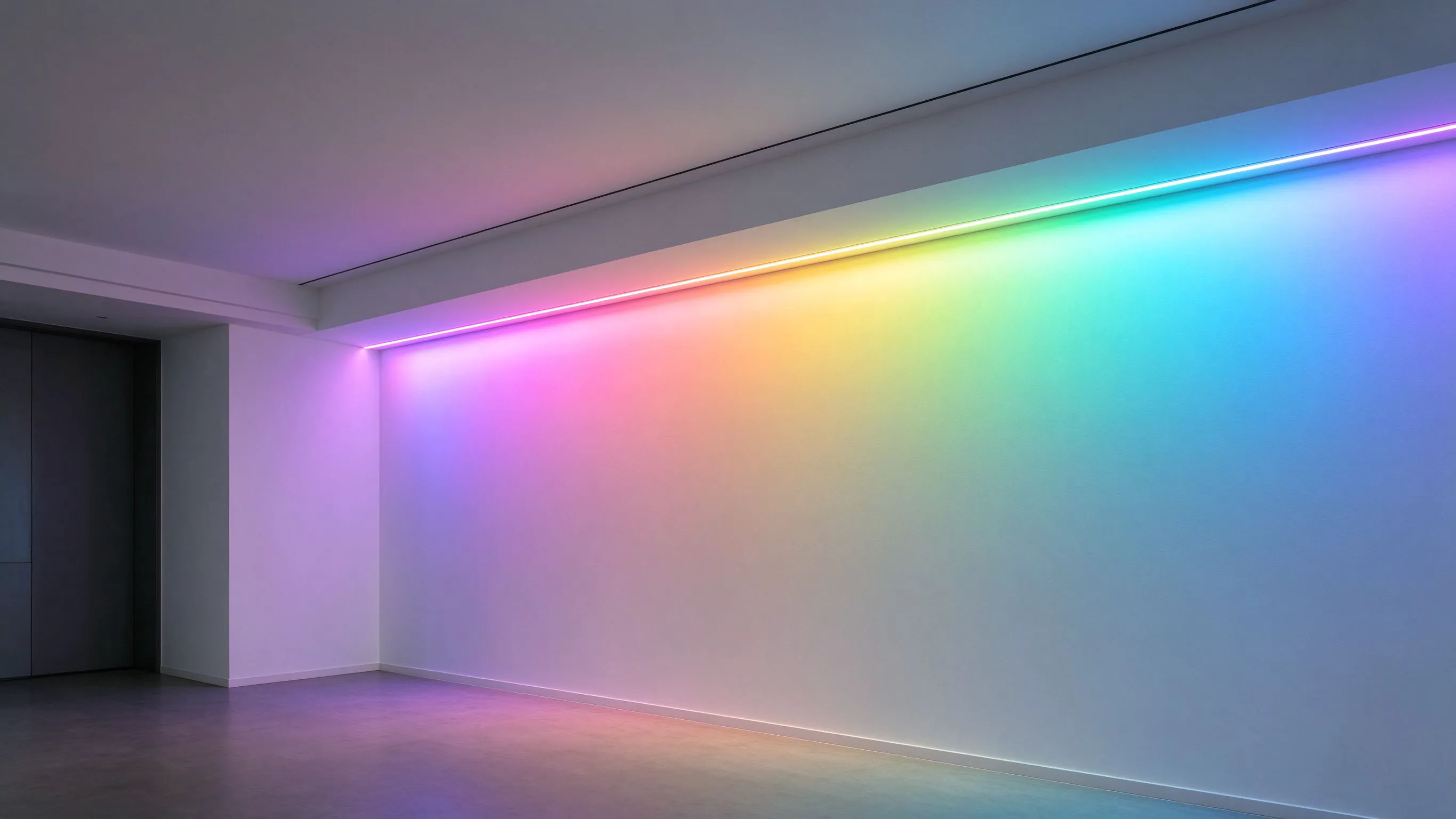
Why Traditional RGB Looks Dotted
Classic RGB strip is built from spaced 5050 packages, each a discrete red-green-blue cluster. At a distance and behind a deep diffuser it can look acceptable, but in coves, shallow channels and close-view feature lighting the individual packages read as dots, and mixed colours can show faint colour fringing where the red, green and blue points do not fully overlap.
Clients often blame the diffuser or the controller for this, but the root cause is the emitter geometry: widely spaced point sources cannot blend into a perfectly smooth line over a short distance.
How RGB COB Fixes the Blend
- Dense chip-on-board emitters packed into a continuous glowing bar.
- Far shorter blending distance, so shallow channels still look smooth.
- Cleaner mixed colours as red, green and blue sources overlap tightly.
- No visible stepping along the run when dimming or chasing colour.

For dot-free colour I use the RGB COB 630-LED 10mm board. The high emitter density does for colour what white COB did for white: it turns a row of points into a continuous wash.
RGB COB vs Conventional RGB SMD
COB wins on smoothness; SMD can still suit deep, distant coves.
| Factor | RGB 5050 SMD | RGB COB |
|---|---|---|
| Visible dots | Yes, up close / shallow cover | Essentially none |
| Blending distance | Needs deeper diffuser | Blends very quickly |
| Mixed colour smoothness | Possible fringing | Tight, even overlap |
| Per-channel output | Can be high per package | Smooth but density-dependent |
| Shallow-channel look | Striated | Seamless |
Where Dot-Free Colour Matters Most
- Hospitality coves and bar fronts viewed at close range.
- Shallow channels and slim profiles with little room for a deep diffuser.
- Retail feature and brand-colour walls where colour must be perfectly even.
- Spa and wellness spaces where a soft, calm colour wash is the whole effect.
- Backlit signage and light boxes that need smooth colour rather than dots.
Understanding Colour Mixing Distance
Even RGB COB is not magic at zero distance. The red, green and blue emitters still need a small space, or a diffuser, to overlap into a single perceived colour. The advantage of COB is that this distance is dramatically shorter than SMD, so a shallow frosted cover or a few centimetres of bounce is usually enough. If you look directly at a bare RGB COB at close range you may still discern coloured micro-points; the seamless result appears once the light has blended, exactly as with white COB but slightly more demanding because colour mixing is involved.
Output, Heat and Power for Colour
Dense colour emitters draw real power, especially on white and bright pastel scenes where multiple channels run together. I size drivers for the all-channels-on load rather than a single colour, mount the strip to its aluminium profile for heat, and I am upfront that saturated single colours can look brighter per watt than white mixes, which split the output across channels. Planning the driver around peak white avoids under-powering the scenes clients actually use most.
Control, Dimming and Colour Consistency
- Use a quality RGB controller and constant-voltage dimming for smooth, flicker-free fades.
- Match product batches on long runs; colour binning can vary between manufacturing lots.
- Inject power at intervals so the colour at the end of a long run matches the start.
- Prefer profiles and diffusers rated for the strip width to keep the blend consistent.
I commission colour scenes in person rather than trusting a phone photo, because cameras misrepresent saturation. Viewing the intended brand colour and a warm-white mix on the actual wall at night is the only reliable way to confirm the result.
When RGB COB Is and Isn't Worth It
I specify RGB COB whenever the colour is visible up close or behind a shallow cover, which is most high-end interior colour work. It is less critical in deep coves viewed from far away, where cheap 5050 strip hides behind enough diffusion, or in projects where only a single saturated colour is shown at distance and dots never resolve. Matching the product to the viewing geometry avoids paying for density the application will never reveal.
Specifying a Dot-Free Colour Project
Send the channel depth and diffuser type, the viewing distance, the colours and white scenes you need, run length and desired control. I will confirm whether RGB COB is the right fit, the driver load for white scenes, and power-feed spacing. We supply the RGB COB 630-LED board and recommend a short lit sample behind the actual diffuser so the colour smoothness and brightness can be judged before fitting out.
Five Colour-Scene Mistakes I Fix Most Often
- Running saturated colour at full output all evening. It fatigues the eye and washes out the space; pastel and muted mixes read as more premium.
- Expecting white from RGB without checking the mix. Uncalibrated RGB white often runs green or magenta; set and save the white point on the actual wall.
- Too-fast colour transitions. Rapid sweeps feel like a gaming arcade in a restaurant or hotel; slow fades suit hospitality.
- Ignoring the diffuser. Even RGB COB benefits from a shallow cover; bare colour up close can still show micro-points.
- Under-sizing drivers for white scenes. White and pastel scenes run multiple channels together and draw the most power, so size for that load.
The pattern behind all five is treating colour lighting as a set-and-forget demo rather than a designed layer. On one lounge fit-out the client loved the controller's rainbow chase during handover and ran it for the first week, then noticed customers stayed for less time and the room felt cheaper than the fit-out budget implied. We replaced the default loop with three saved states: a warm near-white for service hours, a slow muted brand-colour breathe for the evening, and a static deep accent for late night. Dwell time recovered and the staff stopped touching the controller. The lesson is that smooth RGB COB removes the hardware flaw, the dots, but the design flaw, inappropriate scenes and levels, still has to be designed out. I always hand over a small set of calibrated, named scenes rather than leaving the client to browse hundreds of presets, because the best colour installations are the ones that run the same three tasteful states every day without anyone adjusting them.
Recommended Products
Frequently Asked Questions
What is RGB COB and why is it smoother than normal RGB strip?
RGB COB packs dense red, green and blue emitters into a continuous chip-on-board bar instead of spaced 5050 packages. The tightly packed sources overlap and blend over a much shorter distance, producing a seamless colour wash with no visible dots or stepping, especially in shallow channels and close-view coves.
Does RGB COB need a diffuser to look smooth?
It blends far faster than SMD and often looks smooth behind only a shallow frosted cover or after a few centimetres of bounce. At zero distance a bare board may still show coloured micro-points, so for perfect mixed colour provide a small blending distance or a diffuser, just less than conventional RGB requires.
Is RGB COB bright enough for white scenes?
It can produce white by mixing all channels, but white and pastel scenes split output across red, green and blue and draw the most power. Size drivers for the all-channels-on load, not a single colour, and mount to an aluminium profile for heat. For high-CRI true white as the primary use, a dedicated white or RGBCW product is often better.
Where should I use RGB COB instead of cheap 5050 strip?
Use RGB COB for close-view hospitality coves, shallow channels, retail brand walls, spas and light boxes where dots would be visible. In deep coves viewed from far away, or single saturated colours at distance where dots never resolve, cheaper 5050 strip behind enough diffusion can be adequate.
How do I keep colour consistent along a long RGB COB run?
Inject power at planned intervals to prevent voltage drop, use a quality constant-voltage RGB controller for flicker-free fades, and use strip from the same manufacturing batch on long runs because colour binning can differ between lots. Confirm brand colours and white mixes on the actual wall at night rather than from photos.
Need help with your LED project?
Get factory-direct pricing, free samples and engineering support within 24 hours.
Email: info@arraystarled.com | Phone: +86-0755-2103-6746 | WhatsApp: 0086 1581 8514 077
Need to size your power supply? Use our LED Strip Power Calculator to find the right driver in seconds.