
SP107E Bluetooth Music Controllers for Sound-Reactive LED
- 2026-10-09 18:41
- /
- Arraystar LED
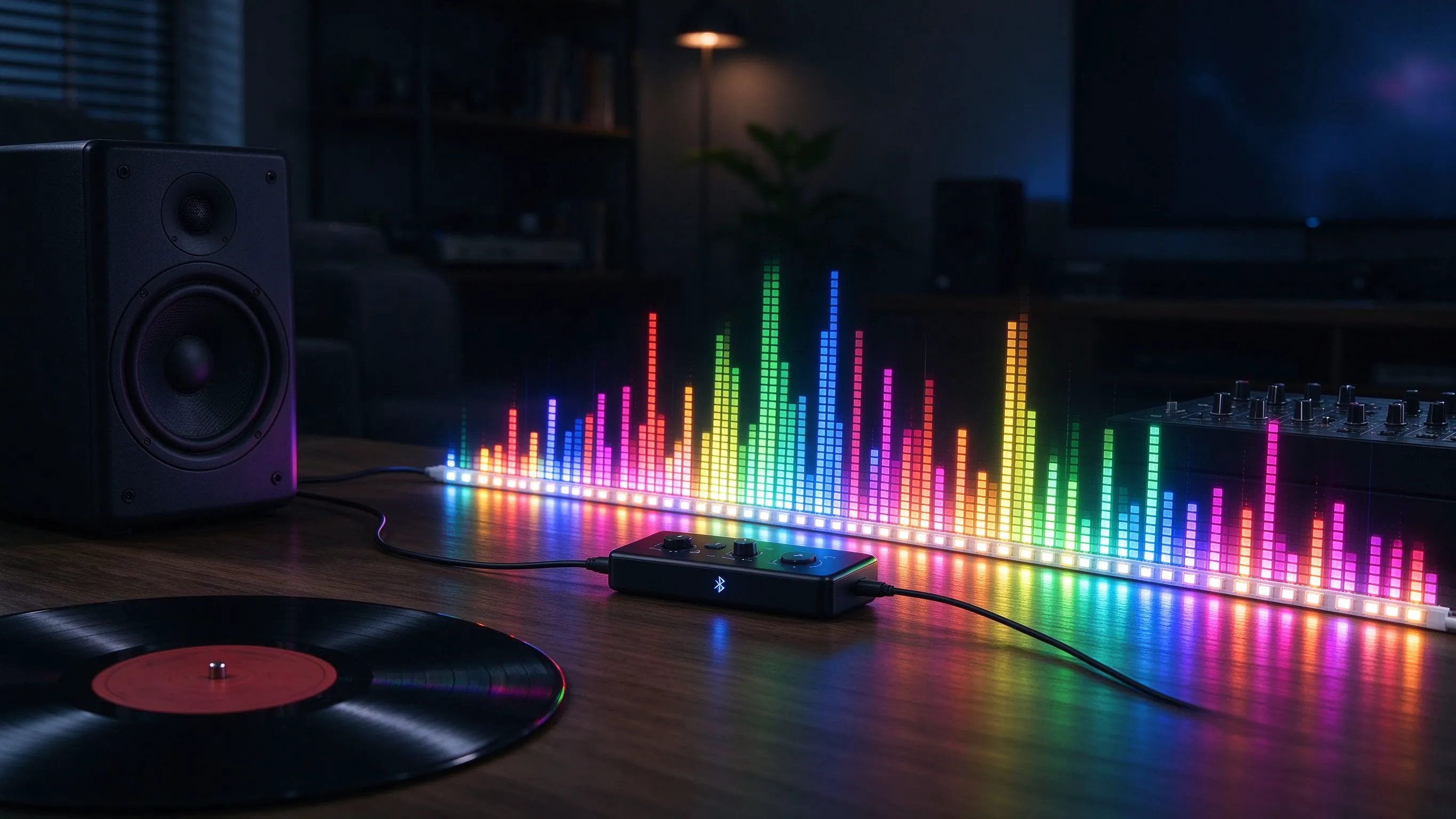
Sound-reactive LED is the signature effect of bars, gaming rooms, home theatres and party spaces, and it needs a controller that listens to audio and maps it to pixels in real time. The SP107E Bluetooth music controller does this from a built-in microphone or an audio line-in, with phone control over sensitivity and effect style, making music-reactive pixel lighting straightforward without a media server.
Why Ordinary Effects Do Not React to Music
Standard pixel controllers run pre-set animations at a chosen speed, but they cannot hear. A chase that runs at a fixed tempo ignores the beat, and in a music-driven space such as a bar, club corner, gaming room or home theatre that disconnect between sound and light is immediately noticeable and underwhelming.
Sound-reactive lighting needs a device that captures audio, analyses its volume and frequency, and updates the pixels fast enough to feel genuinely tied to the music rather than lagging behind it.
What the SP107E Music Controller Does
- Built-in microphone for picking up ambient sound.
- Audio line-in for a direct, cleaner music signal.
- Real-time sound-reactive effects mapped to beat and frequency.
- Bluetooth phone control of mode, sensitivity, colour and brightness.
- Compact, media-server-free setup for reactive lighting.
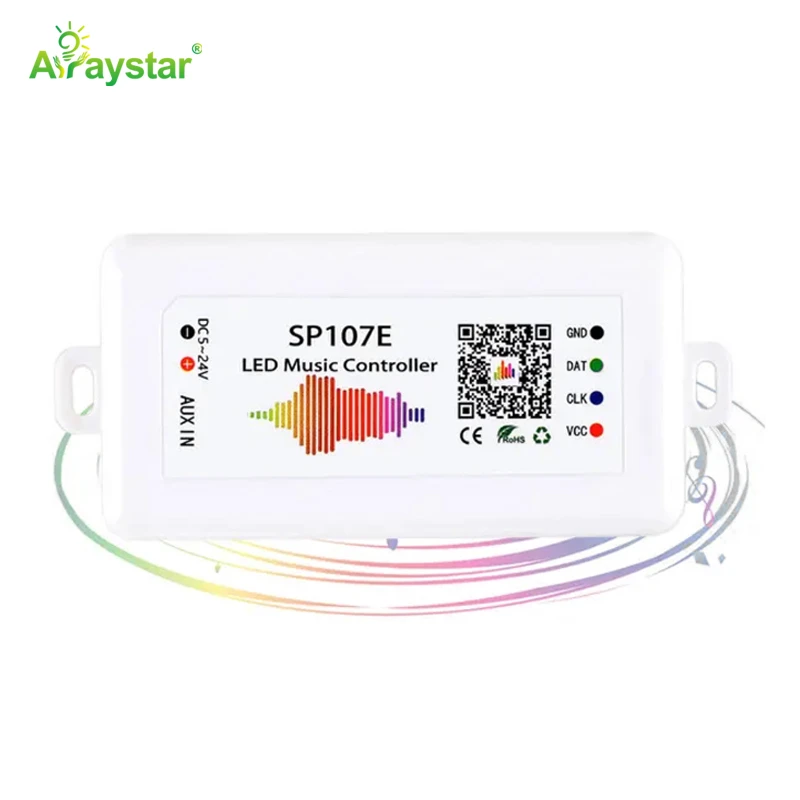
For music-reactive pixels at a small to medium scale I use the SP107E. It listens to the audio and drives the strip directly, with no PC or media server required.
Mic Input vs Line-In: Which to Use
Use line-in whenever the music source can be reached for a tight reaction.
| Input | Best for | Trade-off |
|---|---|---|
| Built-in mic | Rooms where wiring is hard, ambient reaction | Picks up noise and chatter; less precise |
| Audio line-in | DJ booths, theatres, reliable beat tracking | Needs an audio feed/cable |
| Bluetooth control | Configuring from the phone | Carries settings, not necessarily the audio source |
The microphone is convenient and genuinely reacts to the room, but in a noisy bar it also responds to crowd noise and speech, which can make the effect jittery. When I can take a feed from the DJ mixer, sound system or media player, the line-in gives a clean music-only signal and far tighter beat response.
Where Sound-Reactive Pixels Are Specified
- Bars, lounges and small club dance floors.
- Home theatres, gaming rooms and man-caves.
- Party and event spaces, mobile DJ setups.
- Karaoke rooms and entertainment venues.
- Retail or exhibition stands wanting lively ambient motion.
Tuning Sensitivity and Effect Style
A music controller only looks good if it is tuned to the space. Sensitivity set too high makes the strip flash constantly to background noise; too low and it misses quiet passages. I set the threshold so the strip rests during silence and responds cleanly to the beat, choose effects that match the venue (frequency-spectrum colour spreads for music, simpler beat flashes for speech-heavy spaces), and lock a sensible default so staff cannot leave it in an extreme mode.
- Raise/lower sensitivity until silence gives a calm resting state.
- Match effect complexity to the venue and music style.
- Prefer line-in to avoid crowd-noise triggering in busy venues.
- Save a tuned default and restrict chaotic modes where needed.
Setting Realistic Expectations on Analysis
A compact music controller reacts primarily to overall volume and frequency bands; it is not a professional beat-sliced or timecode-synchronised lighting console. For a bar or home theatre that is exactly the right level of capability, producing lively, convincing reactivity. For a touring show needing frame-locked, song-programmed lighting, a media server or DMX console is the correct tool, and I steer clients there rather than overselling a small music controller.
Power, Wiring and Placement
The SP107E provides control, so the strip is powered from a separate sized driver with common ground. For the microphone version, placement matters: I position the controller where it hears the speakers evenly rather than near a single loud source or HVAC noise, while the line-in version can be hidden anywhere because it does not depend on acoustics. As always, size power for full-white and inject on longer runs.
Specifying Sound-Reactive Lighting
Send the venue type, whether a direct audio feed is available, the strip IC and pixel count, run lengths and how energetic the reaction should be. I will confirm the SP107E, mic versus line-in setup, a compatible driver and tuned settings. We supply the SP107E and recommend testing it in the actual room at real music volume, because sensitivity and effect choice can only be finalised against the space's own acoustics and noise.
Tuning a Gaming Room So the Light Follows the Action
A client building a dedicated gaming and streaming room wanted the pixel cove and the strip behind the monitor wall to react to both music and game audio without the lag and false-triggering he had experienced with a cheap app-controlled kit. The room is also used for streaming, where uncontrolled flashing looks poor on camera and can overwhelm the face lighting, so the brief was reactive but disciplined rather than a constant strobe.
- Take a line-in feed from the PC or mixer rather than relying on the microphone, so keyboard noise and speech do not trigger the lights.
- Use gentler spectrum and breathing modes for ambient gaming, reserving strong beat flashes for music scenes.
- Cap brightness and flash rate so the cove reacts without flaring on camera or washing out the streamer's face lighting.
- Set a calm static or slow-drift idle state so quiet moments on screen do not leave the room dead.
- Save separate profiles for gaming, music and movie modes and switch between them from the phone.
We installed the SP107E with a line-in from the room's audio output, which immediately solved the false triggering that the microphone version had caused in his earlier setup; mechanical keyboard clicks and commentary no longer fired the effects because the controller heard only the programme audio. We then spent time tuning sensitivity per profile, which is the step most people skip and the reason their music lights feel either numb or epileptic. For gaming we chose a slow spectrum wash that shifted colour with the audio energy rather than snapping to every sound effect, keeping the room dynamic without distracting from the screen; for music evenings a punchier beat mode made the cove feel alive; for movies a low-gain breathing effect kept the light subtle. Capping the flash rate mattered for the camera, where full-speed strobing dominated the frame. The result was a room that genuinely responded to content while remaining usable on stream, which a one-size default music mode would never have delivered. The case is my reminder that a music controller's quality is decided less by the hardware than by taking the time to tune inputs, sensitivity and per-scene profiles to the specific room and its cameras.
Recommended Products
Frequently Asked Questions
What is the SP107E Bluetooth music controller?
It is a compact pixel controller that captures audio through a built-in microphone or an audio line-in and drives addressable strip with real-time sound-reactive effects that respond to beat and frequency, with Bluetooth phone control over mode, sensitivity, colour and brightness. No media server is needed.
Should I use the built-in mic or an audio line-in?
Use the microphone for convenience where running a cable is hard and ambient reaction is acceptable; it also picks up crowd noise and speech, which can cause jitter in busy bars. Use the line-in from a DJ mixer, sound system or media player whenever possible for a clean music-only signal and much tighter, more reliable beat response.
How do I stop sound-reactive LEDs flashing to background noise?
Lower the sensitivity threshold in the app so the strip rests calmly during silence and only responds to genuine beat-level sound, and prefer a line-in feed over the microphone in noisy venues so crowd chatter does not trigger it. Choose an effect style suited to the space and save a tuned default.
Is the SP107E as precise as a professional lighting console?
No. It reacts mainly to overall volume and frequency bands, which is lively and convincing for bars, home theatres and party spaces but not frame-locked or song-programmed. For touring shows or timecode-synchronised lighting, use a media server or DMX console rather than a compact music controller.
Does the SP107E power the strip and where should it go?
It supplies control, not LED power; run the strip from a separate driver sized for full-white current with common ground and inject power on long runs. For the mic version, place it where it hears the speakers evenly and away from HVAC or single loud sources; the line-in version can be hidden anywhere since it does not rely on room acoustics.
Need help with your LED project?
Get factory-direct pricing, free samples and engineering support within 24 hours.
Email: info@arraystarled.com | Phone: +86-0755-2103-6746 | WhatsApp: 0086 1581 8514 077
Need to size your power supply? Use our LED Strip Power Calculator to find the right driver in seconds.







