SP801E ArtNet WiFi Controllers for Multi-Universe Pixel Shows
- 2026-10-09 18:41
- /
- Arraystar LED
When a pixel matrix grows beyond a single controller's capacity or must play video-synced content from media software, the control has to move to ArtNet/E1.31 over the network. The SP801E WiFi ArtNet controller receives multiple universes and drives large pixel arrays in sync with software such as MADRIX or Resolume, bridging the gap between a phone app controller and a full professional media-facade system.
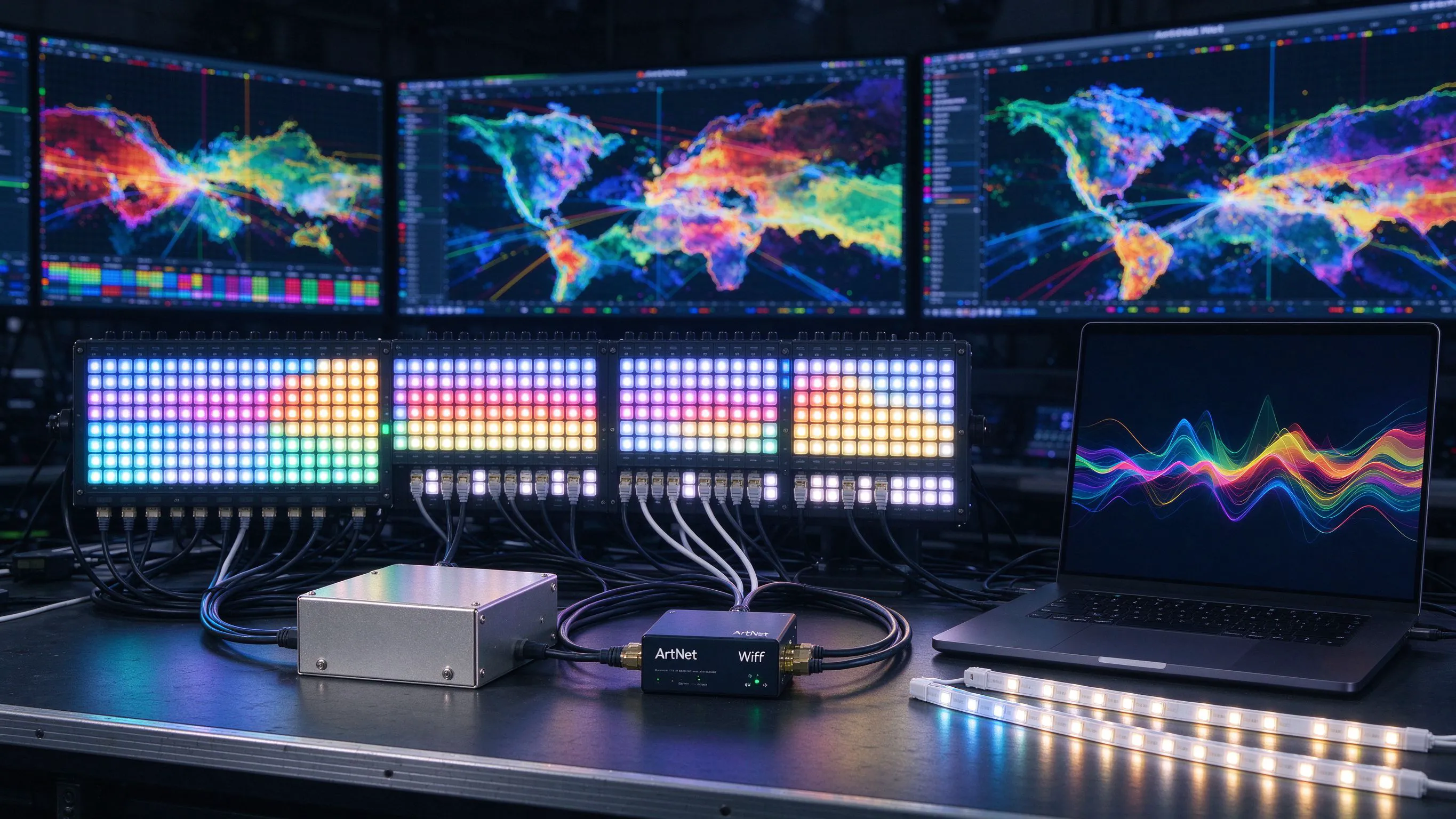
When App Controllers Run Out of Room
Entry WiFi controllers are fine for a single zone of built-in effects, but two requirements quickly exceed them: a matrix with more pixels than one device can refresh, and content that must be generated by media software and stay frame-synchronised, such as video-mapped walls, VJ-driven installations or audio-reactive stage pieces.
Those projects speak ArtNet or E1.31 (sACN), the network protocols that carry lighting data from software to controllers, and they need a controller that can receive those universes rather than just run onboard effects.
What the SP801E Adds
- ArtNet / E1.31 reception over WiFi or network.
- Multiple-universe handling for larger pixel matrices.
- Software-driven content from MADRIX, Resolume, Jinx! and similar tools.
- Configurable IC type, channel order and matrix mapping.
- A compact bridge between media software and addressable strip.
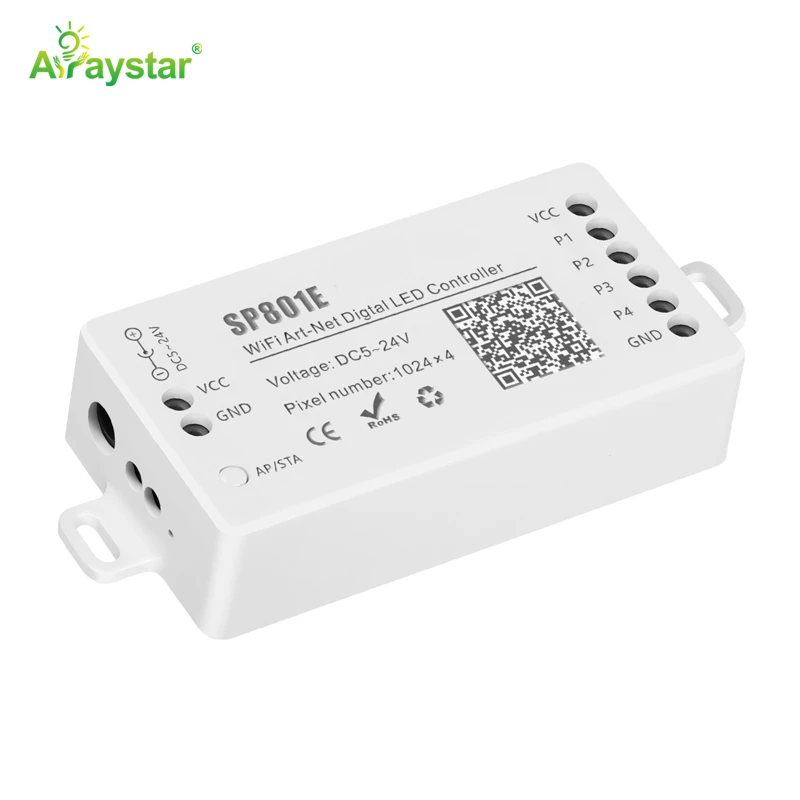
For software-driven pixel matrices that have outgrown an app controller, I use the SP801E. It receives the universes the software streams and maps them onto the physical strip layout.
App Controller vs ArtNet Controller
Move to ArtNet when content comes from software or pixels exceed one zone.
| Capability | App controller (SP108E class) | SP801E ArtNet |
|---|---|---|
| Content source | Onboard effects / phone | External media software |
| Protocol | Proprietary app | ArtNet / E1.31 |
| Multi-universe | Limited | Yes |
| Video / VJ sync | No | Yes |
| Typical scale | Single zone | Medium matrices and walls |
Where the SP801E Fits
- Medium LED matrices and pixel walls driven from a PC.
- Club and stage pieces synced to VJ or media-server content.
- Audio-reactive installations run from lighting software.
- Makers and small studios moving up from app control.
- Projects needing a few universes without a full facade-grade rig.
Mapping the Matrix in Software
The critical setup task is telling both the controller and the software how the physical pixels are arranged: the matrix dimensions, how the strip snakes row by row, the IC protocol and the colour order. I configure the layout once in the SP801E and match it exactly in the media software, because a mismatch produces mirrored, rotated or scrambled output that looks like a hardware fault but is purely mapping. I always validate with a simple numbered or colour-bar test pattern before playing real content.
- Set matrix width and height to the true physical layout.
- Define the serpentine/snake direction of the strip runs.
- Match IC type and RGB/RGBW order on both devices.
- Test with colour bars or coordinates before running shows.
Network, WiFi and Synchronisation Reality
ArtNet over WiFi is convenient but it is the least deterministic part of the chain; a crowded wireless network can drop or delay universes and cause stutter. For reliable shows I prefer a wired network connection where the controller supports it, or a dedicated isolated WiFi network with no other traffic, and I keep the number of universes within what the link and controller can sustain at the desired frame rate. Understanding this boundary prevents a smooth studio demo becoming a stuttering installation.
Power and Scale Limits
As with any pixel controller, the SP801E supplies data, not the LED load; the matrix is powered from separate drivers sized for full white with regular injection. And while it handles multiple universes, a very large permanent facade still steps up to dedicated Ethernet ArtNet-DMX hardware with many ports. I position the SP801E as the professional-but-compact tier: excellent for software-driven medium installations, not the backbone of a building-scale media facade.
Specifying a Software-Driven Matrix
Send the matrix dimensions and total pixels, the media software you use, the content type (video, VJ, audio-reactive), whether wired or WiFi networking is available and the desired frame rate. I will confirm whether the SP801E covers the universe count or whether larger facade controllers are needed, plus mapping and power. We supply the SP801E and recommend bench-testing the full matrix mapping with a colour-bar pattern before installation.
Choosing Between the SP801E and Facade-Grade Control
Clients often ask at what point a project should step up from a compact ArtNet controller to a full facade-grade rig, and I answer with three thresholds rather than a hunch: total pixel count, the need for unattended reliability, and whether the network can be dedicated. Below those thresholds the SP801E is the smarter, cheaper, faster choice; above any one of them, engineered multi-port facade hardware pays for itself.
- Pixel count within a few universes and a single controller's refresh: SP801E is adequate.
- An operator or PC present during the show: the SP801E's software-driven model fits.
- A wired or dedicated isolated network available: ArtNet stays stable on the compact device.
- Thousands of pixels, 24/7 unattended duty or a shared IT network: step up to facade-grade EN-508 class hardware.
A practical example: an independent bar installing a three-metre by one-metre pixel wall behind the DJ booth, run from a laptop on MADRIX during opening nights, sat comfortably in the SP801E tier. It needed software-driven video content and a couple of universes, which the compact controller handled over a wired connection to the show laptop, and the budget saved versus a facade rig went into better pixel density. By contrast, when the same bar's owners later quoted a permanent exterior canopy across their shopfront that had to run unattended all evening on the building's shared network with no laptop present, I moved them to engineered facade controllers rather than installing several SP801E units and hoping they would behave like 24/7 infrastructure. The decision is not about which device is better in isolation; it is about matching the controller's operating assumptions, attended software-driven versus unattended infrastructure, to how the feature will actually run. I find that drawing this line clearly at quotation stage prevents the two most common expensive mistakes: over-buying facade hardware for a small attended feature, and under-buying compact controllers for a permanent exterior that then needs replacing within a season.
Recommended Products
Frequently Asked Questions
What is an SP801E ArtNet controller used for?
It receives ArtNet or E1.31 lighting universes over a network and drives addressable pixel matrices in sync with external media software such as MADRIX, Resolume or Jinx!, handling multiple universes for larger walls than a phone-app controller can refresh. It bridges media software and physical pixel strip.
When should I move from an app controller to ArtNet?
When the pixel count exceeds a single app controller's refresh capacity, or when content must come from media software and stay frame-synchronised, such as video-mapped walls, VJ shows or audio-reactive stage pieces. App controllers are built for onboard effects in one zone, not networked software-driven content.
How do I map a pixel matrix to the SP801E?
Set the true matrix width and height, define how the strip snakes row by row, select the correct IC type and RGB/RGBW order in both the controller and the media software, then validate with colour bars or a numbered test pattern. Mirrored or scrambled output is almost always a mapping mismatch, not a hardware fault.
Is ArtNet over WiFi reliable for pixel shows?
It can work but WiFi is the least deterministic link; a crowded network can drop or delay universes and cause stutter. Prefer wired networking where supported, or use a dedicated isolated WiFi network with no other traffic, and keep the universe count within what the link sustains at your target frame rate.
Does the SP801E power the LED matrix?
No, it provides control data; the LEDs are powered from separate constant-voltage drivers sized for full-white current with regular injection. For very large permanent facades with many universes and ports, step up to dedicated Ethernet ArtNet-DMX hardware rather than stretching the compact SP801E.
Need help with your LED project?
Get factory-direct pricing, free samples and engineering support within 24 hours.
Email: info@arraystarled.com | Phone: +86-0755-2103-6746 | WhatsApp: 0086 1581 8514 077
Need to size your power supply? Use our LED Strip Power Calculator to find the right driver in seconds.