
WS2812B vs WS2815 vs SK6812/SK6813 vs UCS2904: Which Addressable LED IC I Spec and Why
- 2026-10-08 17:37
- /
- Arraystar LED
Addressable strips look interchangeable on a listing - 'pixel LED, 5050, digital' - but the IC choice decides voltage, whether one dead pixel blacks out the whole run, whether you get real warm white, how forgiving the wiring is, and which controllers will drive it. WS2812B is the cheap 5V hobby standard that drops voltage fast and has no fault tolerance; WS2815 moves to 12V and adds a backup data line so a single failed pixel does not kill everything after it; SK6815 takes that idea to 24V for long installs; and UCS2904 adds a dedicated white channel for RGBW. Pick the IC from the install conditions and the controller, not the price tag, and you avoid the two failures that dominate pixel jobs: pink tails and one-dead-pixel blackouts.
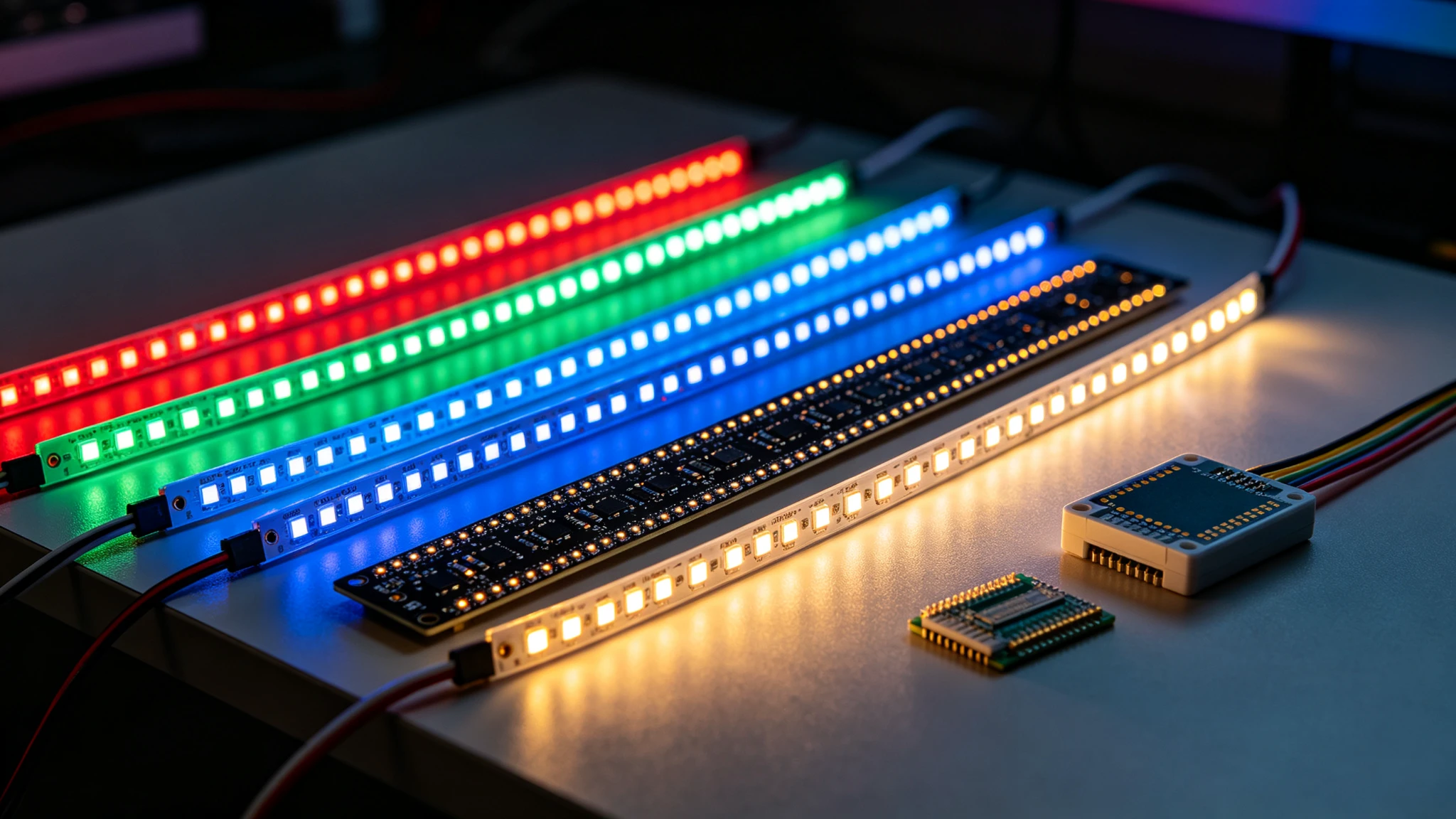
How an Addressable Pixel Actually Works
Inside each addressable LED is a small controller IC (or the IC sits beside the LED on the board). Your controller sends a serial data stream - essentially a chain of colour values - and the first IC reads its own value, then passes the remaining data to the next, and so on down the line. That is why pixels are chained DIN to DOUT in order and why the data timing is tight. Power is separate and shared across the whole run, which is the source of most problems.
- Data line carries the per-pixel instructions; it carries almost no current and must be wired DIN to DOUT in sequence.
- Power (V+ and V-/ground) feeds every pixel and must be injected repeatedly because each pixel draws current.
- RGB pixels make white by mixing red+green+blue; RGBW pixels have a separate dedicated white LED.
- Some ICs pass data on a backup line so a dead pixel does not break the chain; older ones do not.
The ICs Side by Side
Voltage, white channel and backup data are the decisions that matter on site.
| IC | Voltage | Channels | Backup data? | Where I use it |
|---|---|---|---|---|
| WS2812B / WS2811 | 5V (2811 also 12V) | RGB | No | Short hobby/props, cheap builds |
| WS2815 | 12V | RGB | Yes (bidirectional) | General installed work, fault tolerance |
| SK6812/SK6813 | 5V/12V | RGB or RGBW | SK6813 yes | Compact signage, RGBW at low voltage |
| SK6815 | 24V | RGB | Yes | Long runs, less voltage drop |
| UCS2904B | 12V/24V | RGBW | Yes | Warm usable white + color in one run |
Two practical consequences fall straight out of this table. Higher voltage means fewer power-injection points and no pink tail. A backup data line means a single damaged pixel does not turn the rest of the run dark - a big deal on a permanent commercial install where replacing one pixel behind a diffuser is a maintenance job. Both point most professional projects away from raw 5V WS2812B.
WS2815 - My Default for Installed RGB Work
WS2815 runs at 12V and, crucially, carries a backup (bidirectional) data line. If one pixel fails, data still reaches the pixels after it via the backup path, so you lose that one dot rather than the whole tail. At 12V the current per metre is lower than 5V for equivalent power, voltage drop is gentler, and injection spacing is more forgiving. For signage, feature walls, bar fronts and permanent displays this is the balance I default to - cheap enough to bid, robust enough to survive.
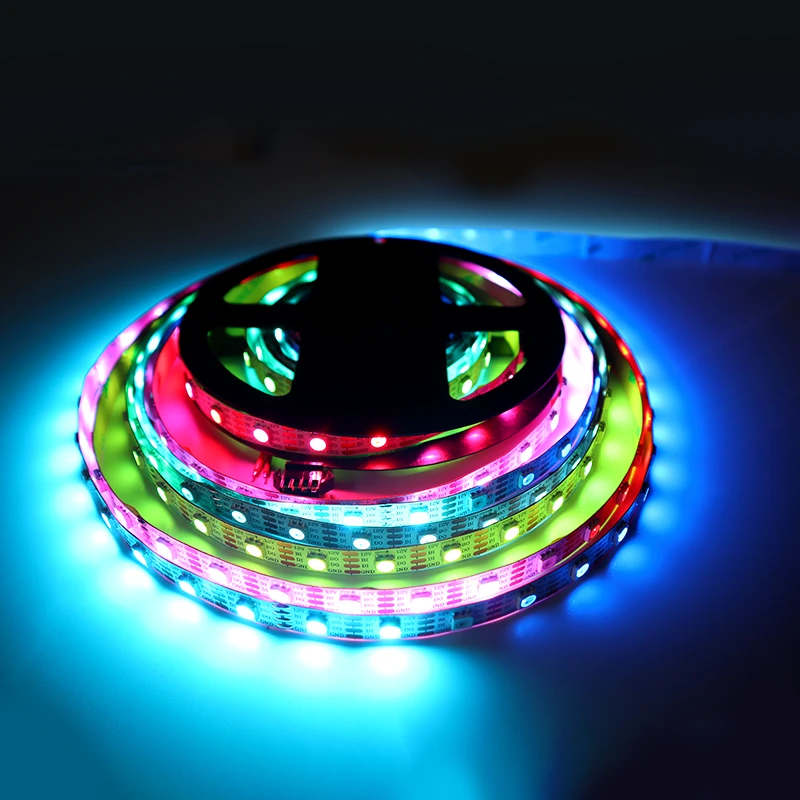
You still inject power at regular intervals and you still wire data in the correct direction, but the combination of 12V and backup data removes the two most common WS2812B failure modes. On anything a customer will see for years rather than a one-off prop, that reliability is worth the small premium.
SK6815 at 24V for Long Runs
When the run gets genuinely long - a long corridor outline, a large ceiling feature, an exterior-scale installation - even 12V means frequent injection. SK6815 takes the same backup-data, fault-tolerant concept to 24V, halving the current again and letting you space power feeds much further apart with thinner cable. It is the same reason I choose 24V or 48V for long static runs, applied to addressable product.
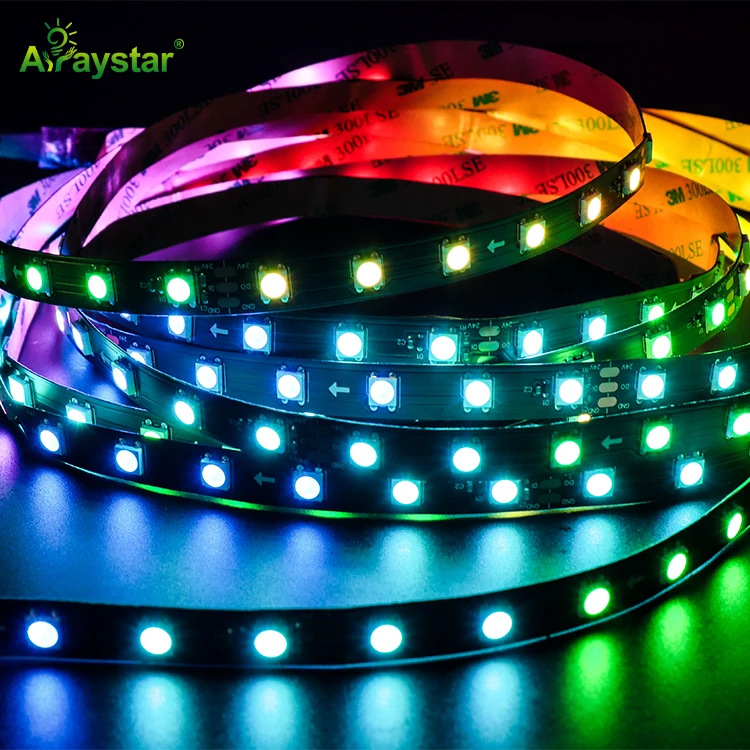
The SK family also includes RGBW variants (SK6812/SK6813) at lower voltages, which are handy in compact channel letters and light boxes where you want a clean white alongside colour without stepping up to a separate white strip. Match the SK variant's voltage and channel count to your controller before ordering.
UCS2904B - When You Need Real White and Color Together
RGB-only pixels make 'white' by firing red, green and blue together, which gives a slightly tinted, often cool or muddy white with visible colour fringing at low brightness - fine for effects, poor when the same run also has to provide pleasant ambient white light. UCS2904B is an RGBW pixel IC with a fourth, dedicated white channel, so you get genuine warm or neutral white for general lighting and full saturated colour for effects from one continuous run.
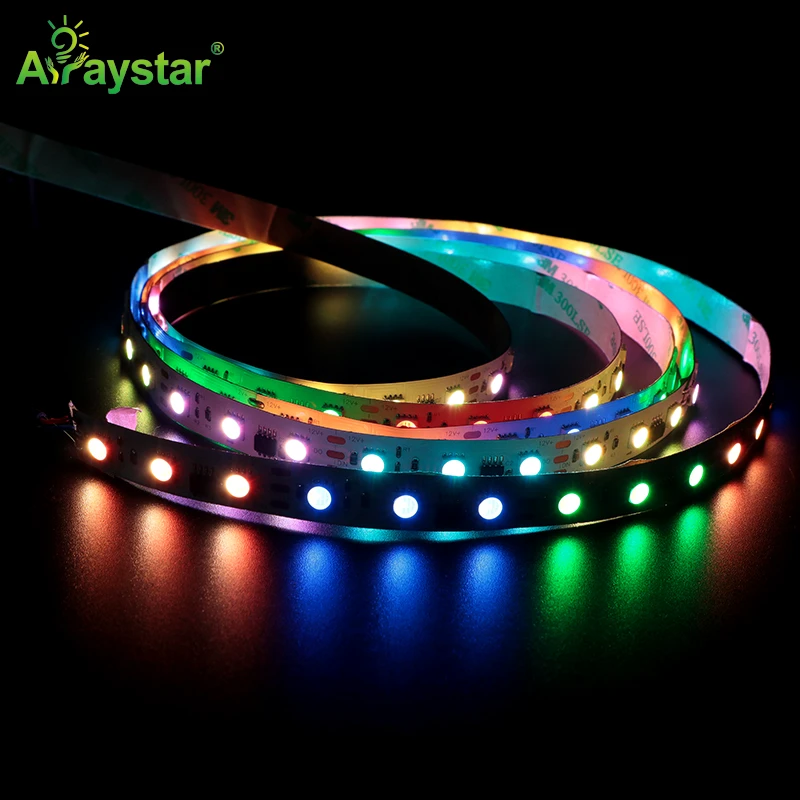
I spec UCS2904B for hospitality and high-end residential jobs where the client wants dynamic colour for evenings but also wants the cove or feature to sit at a comfortable 2700-3000K white the rest of the time. You must use an RGBW-capable controller and set the white channel correctly - an RGB-only controller simply will not drive the fourth LED - so confirm the controller and IC agree before ordering.
Controllers, Power and the Rules That Save Pixel Jobs
- Match controller to IC and channel count (RGB vs RGBW) and to the voltage; confirm supported protocol.
- Inject power every 5V/12V segment as recommended - never run a long pixel reel from one end.
- Connect controller ground to strip ground even when power is injected separately; data needs a common reference.
- Use a level shifter if driving 12V pixels from a 5V microcontroller, and keep the first data wire short.
- For unattended venues use an offline SD-card controller so no computer has to run all night.
- Test each reel's data direction and a sample of pixels before installing behind diffusers.
Get the IC, voltage, controller and injection plan aligned and addressable installs are genuinely predictable. Most 'unreliable pixel strip' I am asked to fix is just 5V WS2812B pushed far beyond the length and single-feed arrangement it was ever meant for.
One rule newcomers miss: data travels far, power does not
The data wire can run a surprisingly long way from the controller to the first pixel, but the power rails cannot, and people constantly confuse the two. I have seen tidy installs with a long data lead that worked perfectly, and equally tidy ones with a single long power feed that faded to orange halfway. Run your data to a convenient starting point, then distribute power locally with injection - adding repeaters where the signal itself must be re-driven - and treat the data and power networks as two separate layouts.
Recommended Products
Frequently Asked Questions
What is the difference between WS2812B and WS2815?
WS2812B is a 5V RGB pixel IC with no backup data line, so voltage drop is aggressive on long runs and one dead pixel can break the chain after it. WS2815 runs at 12V and adds a bidirectional backup data line, giving gentler voltage drop, fewer injection points and fault tolerance - if one pixel fails, data still reaches the rest. For permanent and longer installs I choose WS2815; WS2812B is fine for short, cheap, low-voltage props.
Do addressable LED strips need power injection?
Yes, frequently. The data line carries almost no current, but every pixel draws power from the shared V+ and ground rails, which sag over distance just like static strip. Inject fresh power at regular intervals (sooner on 5V, further apart on 12V and 24V), connect the additional power grounds to the controller ground, and never feed a long pixel reel from one end or the tail will dim and shift colour.
What is the advantage of RGBW pixels like UCS2904?
RGBW pixels add a dedicated white LED alongside red, green and blue. RGB-only pixels fake white by mixing all three colours, which looks tinted, muddy or cool and fringes at low brightness. An RGBW IC such as UCS2904B produces genuine warm or neutral white for ambient lighting while still offering full colour effects, so one run does both jobs. You need an RGBW-capable controller to drive the fourth channel.
Are SK6812 and WS2812B compatible?
They are broadly similar in timing and many controllers support both, but they are not identical - SK6812 variants differ in voltage, come in RGBW versions, and the SK6813 adds a backup data line that WS2812B lacks. Always set your controller to the exact IC protocol, match voltage and channel count, and test a sample reel. Do not assume a controller labelled WS2812 will correctly drive every SK variant, especially RGBW ones.
Why does one dead LED turn off the rest of my pixel strip?
On ICs without a backup data path (such as WS2812B), data passes through each pixel in sequence, so a failed IC cannot forward the signal and everything after it goes dark. ICs with a backup/bidirectional data line - WS2815, SK6813, SK6815 and UCS2904B - keep passing data around a dead pixel, so you only lose that one dot. Specify a backup-data IC on permanent installs where servicing a single pixel is difficult.
Need help with your LED project?
Get factory-direct pricing, free samples and engineering support within 24 hours.
Email: info@arraystarled.com | Phone: +86-0755-2103-6746 | WhatsApp: 0086 1581 8514 077
Need to size your power supply? Use our LED Strip Power Calculator to find the right driver in seconds.







