
Free-Cut LED Strips: Cut Anywhere With No Dead Zones or Wasted Length
- 2026-09-30 17:38
- /
- Arraystar LED
Conventional LED strip only cuts at fixed intervals, which forces every installation into a compromise of leftover dead segments, awkward joins or the wrong finished length. Free-cut technology - in both neon and high-density COB - lets you cut at almost any point without losing a lighting zone, so signs, coves and linear runs finish exactly to size with no dark tails. The trade-off is understanding how the free-cut architecture is wired and powered; once you do, it removes the single most frustrating constraint in linear lighting fabrication.

Fixed Cut Points Are the Old Bottleneck
Standard LED strip has copper cut marks every 25, 50 or 100mm because the LEDs are grouped into fixed series circuits. If your cove, sign stroke or cabinet run ends between two marks, you either leave a dark unlit tail, extend the run to the next mark, or accept a length that doesn't quite fit. Multiply that across hundreds of sign letters or a long cabinet and the waste and dark gaps add up.
Free-cut (also called no-dead-zone or arbitrary-cut) strip restructures the circuitry so cuts can be made at much shorter intervals - in some products essentially anywhere - without extinguishing a section. It exists in both neon form for signage and dense COB form for smooth linear light, and it's become the default for precision fabrication work.
Free-Cut Neon for Signs With No Dark Tails
In signage, free-cut neon is what lets every letter stroke terminate exactly at its end. Top-bend 1010 free-cut neon handles larger letterforms and flat sign patterns that bend across the top face, cutting cleanly so the end of each stroke glows right to the tip rather than finishing in a dark off-cut.
For slightly smaller signage bends, the top-bend 0808 free-cut neon offers a more compact body with the same arbitrary-cut advantage. The key benefit across both is fabrication accuracy: you build the sign to the artwork dimensions rather than stretching or compressing the design to suit the neon's fixed cut grid, which eliminates the dark tails that make budget signs look unfinished.
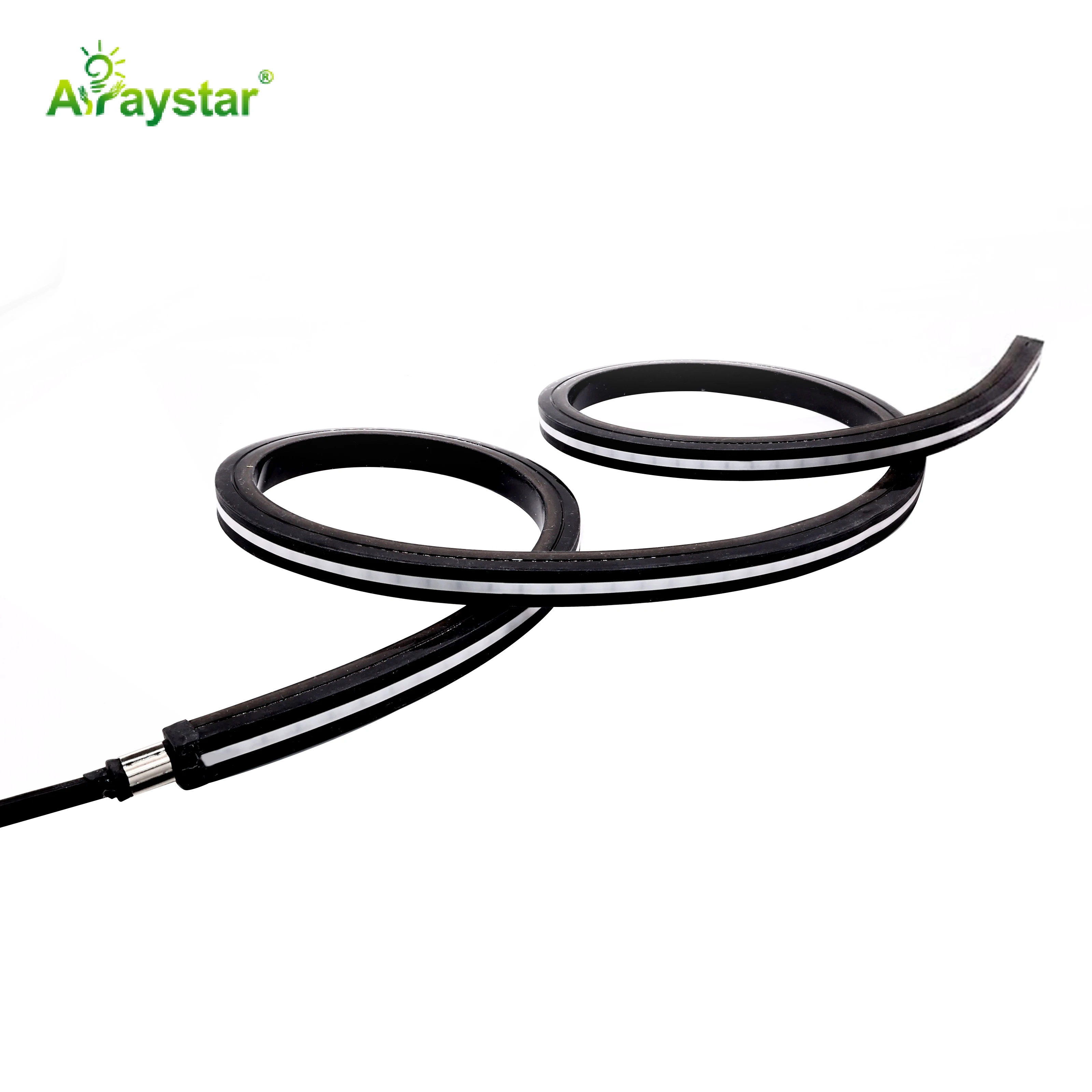
Free-cut products and where each fits.
| Product | Form | Typical free-cut use |
|---|---|---|
| Top-bend 1010 neon | Larger flat neon | Large letters, sign patterns, clean stroke ends |
| Top-bend 0808 neon | Compact flat neon | Smaller signage bends, tighter strokes |
| Free-cut COB 528/8mm | Dense smooth COB | Coves, cabinets, linear runs to exact length |
| Conventional strip | Fixed-interval cut | Budget runs where exact length isn't critical |
Free-Cut COB for Perfect-Length Linear Runs
Outside signage, the same problem appears in architectural and cabinet lighting: a 2.34m cove or an odd-sized shelf that doesn't land on a 50mm cut mark. Free-cut COB solves it on the smooth, dot-free side of the product range.
The free-cut COB 528 in an 8mm width combines very high LED density for seamless light with arbitrary cutting, so coves, under-cabinet runs and shelf lighting terminate precisely at the wall or cabinet edge with no dark remainder and no forced join. For installers doing repeated fitted work - kitchens, wardrobes, display cases - it removes both waste and the visual tell of a run that doesn't quite reach.
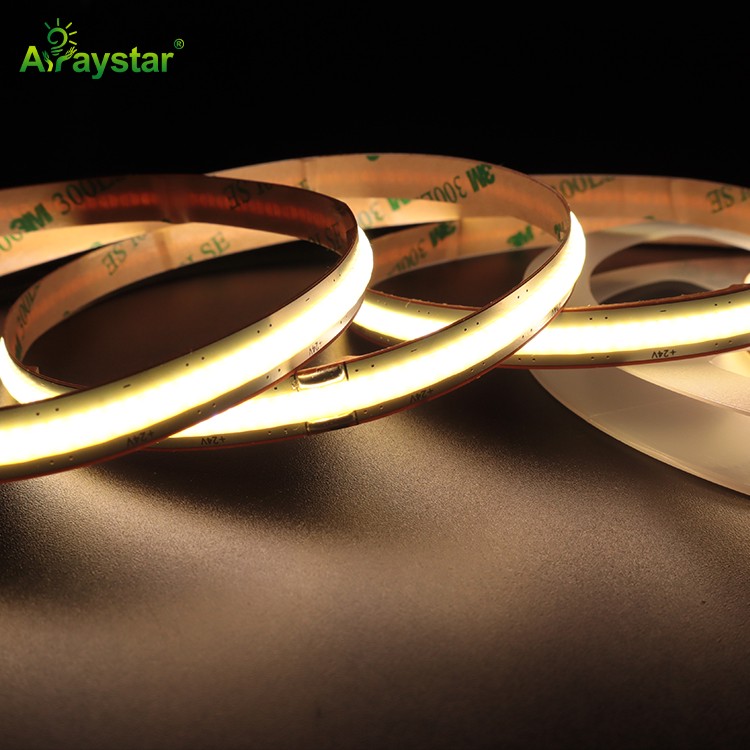
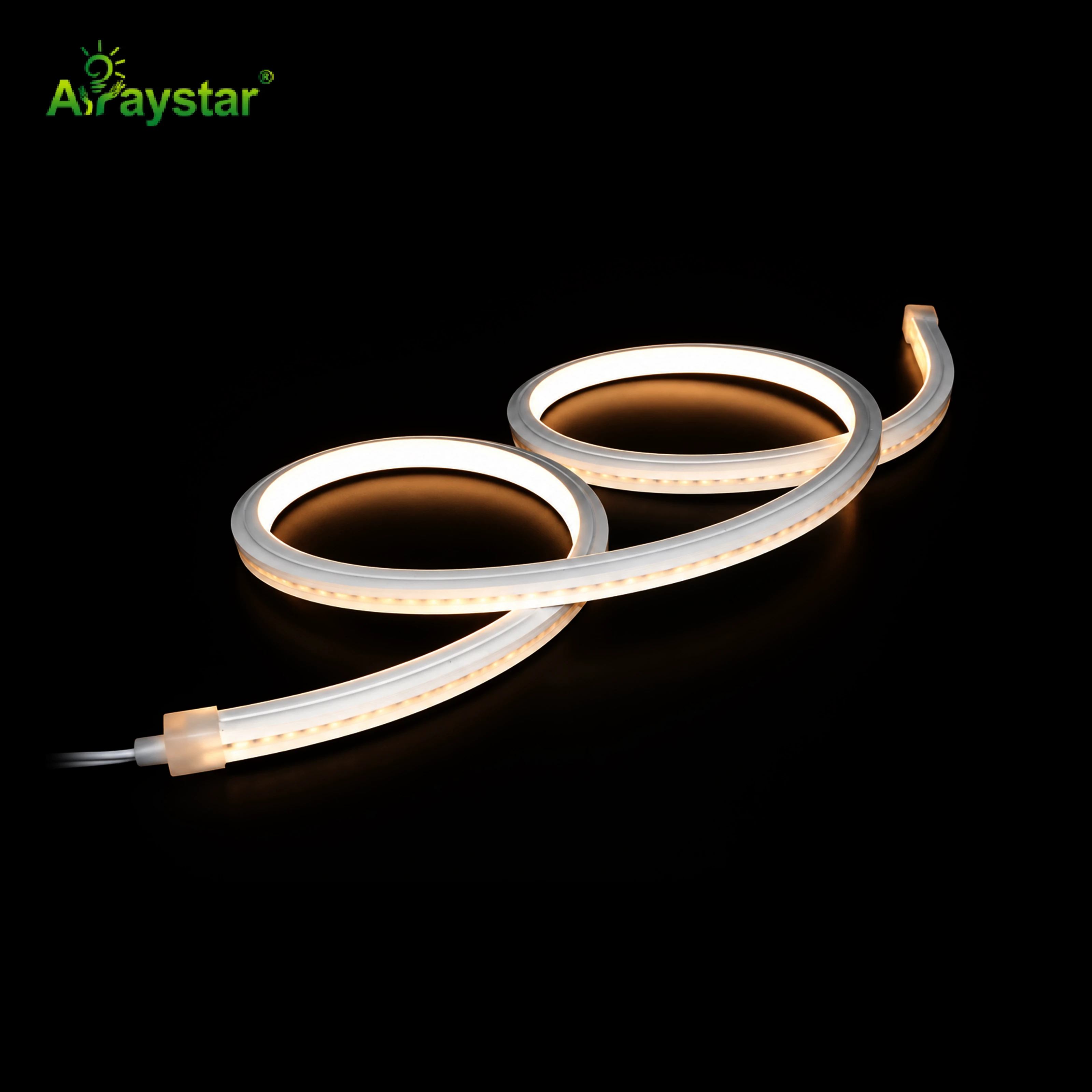
Why no dead zone is technically possible
Free-cut designs use parallel conductor architecture and (in COB) densely packed micro-LEDs arranged so that trimming between the very frequent cut points doesn't break a series string the way conventional strip does. The trade-off is slightly different wiring and power behavior - follow the manufacturer's cut and connection guidance rather than treating it as ordinary tape.
Bend Direction, Connections and Power
- Pick top-bend vs side-bend neon by the plane the sign curves in.
- Cut only at the designated free-cut points even if they're very frequent.
- Use the matched end caps/connectors; arbitrary cuts still need proper termination.
- Account for power injection on long runs - free-cut doesn't remove voltage drop.
- Re-seal cut ends for outdoor or IP-rated signage after trimming.
Free-cut removes the length constraint but not the electrical fundamentals: long runs still need correctly sized wire and power injection, outdoor cuts still need resealing, and each trimmed end still needs the proper cap or connector. Plan the feed points around the sign or cove layout and the no-dead-zone benefit comes through cleanly.
When Free-Cut Is Worth It (and When It's Overkill)
Free-cut earns its premium on fitted, precision and high-volume work: channel letters with many short strokes, custom cabinets and coves to exact dimensions, display cases and anywhere a dark tail would be visible. For rough, hidden or long straight runs where landing on a standard cut mark is fine, conventional strip is perfectly adequate and cheaper - spec the tool to the job rather than defaulting every project to free-cut.
Recommended Products
Frequently Asked Questions
What does free-cut or no-dead-zone LED strip mean?
It's strip engineered with very short (sometimes effectively arbitrary) cut intervals, so you can trim at almost any point without extinguishing a section, unlike conventional strip that only cuts every 25-100mm and leaves dark dead tails. It's available as neon for signage and as dense COB for smooth coves and cabinets.
What is the advantage of free-cut neon for signs?
Every letter stroke can terminate exactly at its tip rather than ending in a dark off-cut or being stretched to a fixed cut mark, so the sign matches the artwork precisely and looks finished. Top-bend 1010 suits larger letters and 0808 more compact bends, both cutting cleanly with no dead zones.
Can I cut free-cut COB anywhere for coves and cabinets?
Free-cut COB (such as the 528/8mm) trims at very frequent points so coves, shelves and under-cabinet runs finish exactly at the wall or cabinet edge with no dark remainder. Cut at the designated free-cut points, fit the proper connector/end cap, and still plan power injection for long runs - arbitrary cutting doesn't eliminate voltage drop.
What's the difference between top-bend and side-bend free-cut neon?
Top-bend neon curves across its flat top face and is used for letters and patterns laid flat on a sign board; side-bend neon curves the other way for outlines that bend laterally. Choose based on the plane the design bends in - using the wrong bend type forces kinks or prevents the shape from sitting flat.
Is free-cut strip worth the extra cost?
It pays off in fitted precision work - channel letters with short strokes, custom kitchens and wardrobes, display cases and anywhere a dark tail would show. For long hidden straight runs that land fine on standard cut marks, conventional strip is adequate and cheaper, so use free-cut where exact termination is visible and valuable.
Need help with your LED project?
Get factory-direct pricing, free samples and engineering support within 24 hours.
Email: info@arraystarled.com | Phone: +86-0755-2103-6746 | WhatsApp: 0086 1581 8514 077
Need to size your power supply? Use our LED Strip Power Calculator to find the right driver in seconds.







