LED Strip Lifespan: How Long Do LED Strip Lights Really Last?
- 2026-09-09 15:48
- /
- Arraystar
Quick Answer
Quality LED strips have a rated lifespan of 30,000-50,000 hours (L70/B50), meaning after 50,000 hours of use, 70% of LEDs still produce at least 70% of initial brightness. At 8 hours/day use, this equals 17 years; at 24 hours/day continuous use, 5.7 years. Actual lifespan depends on: LED chip quality, drive current, heat management, operating environment, and power supply quality. Budget strips may last only 10,000-20,000 hours, while premium strips can exceed 60,000 hours.
Understanding LED Lifespan Ratings
LED lifespan is rated using L70/B50 standards: L70 = the point at which brightness drops to 70% of initial output (the threshold where dimming becomes noticeable); B50 = 50% of LEDs have reached L70. So a 50,000-hour L70/B50 rating means after 50,000 hours, half the LEDs still produce at least 70% brightness. This is different from complete failure—LEDs rarely burn out completely like incandescent bulbs; they gradually dim over time. Rated lifespan is measured under controlled laboratory conditions (25°C ambient, rated current, proper heat sinking). Real-world lifespan may vary based on operating conditions.
Factors Affecting LED Strip Lifespan
1) LED chip quality: High-quality chips (San'an, Epistar, Cree, Nichia) last longer and maintain brightness better than generic/no-name chips. 2) Drive current: Over-driving LEDs (running at higher than rated current) increases brightness but dramatically reduces lifespan. Running at 80% of rated current can double lifespan. 3) Heat management: Heat is the biggest enemy of LEDs. Excessive heat accelerates degradation of the LED chip, phosphor, and solder joints. Proper heat sinking (aluminum PCB, mounting on metal surfaces) is essential. 4) Operating environment: High ambient temperatures (attics, near heat sources), humidity, and vibration reduce lifespan. Outdoor/wet environments require properly rated strips. 5) Power supply quality: Poor quality power supplies with voltage fluctuations, ripple, or surges can damage LEDs and shorten lifespan. Use quality, LED-rated drivers. 6) On/off cycling: Frequent on/off cycling can stress LEDs and reduce lifespan, though modern LEDs handle this better than traditional bulbs.
How to Maximize LED Strip Lifespan
1) Choose quality strips: Invest in strips with name-brand LEDs, thick copper PCB (2oz+), and proper heat sinking. Quality strips have 2-3x longer lifespan than budget strips. 2) Don't over-drive: Run strips at or below rated current. Use dimmers to run at 70-80% brightness for maximum lifespan—you'll barely notice the brightness difference but lifespan doubles. 3) Proper heat sinking: Mount strips on aluminum channels or metal surfaces to dissipate heat. Avoid installing strips in enclosed, unventilated spaces. For high-power strips (>14.4W/m), aluminum channels are essential. 4) Use quality power supplies: Invest in LED-rated drivers with good voltage regulation and low ripple. Avoid cheap, no-name power supplies. Size power supply at 120% of total strip wattage (don't run at 100% capacity). 5) Proper installation: Avoid sharp bends, excessive pulling, and physical stress on strips. Use proper connectors or soldering. Ensure good ventilation around strips and power supplies. 6) Regular maintenance: Clean strips periodically (dust buildup reduces heat dissipation). Check connections for corrosion or looseness. Replace power supplies if they show signs of failure (flicker, buzzing, overheating).
Lifespan Comparison: Budget vs Premium
Budget LED strips ($1-3/m): Typically use generic LEDs, thin copper PCB (0.5-1oz), and minimal heat sinking. Rated lifespan: 10,000-20,000 hours (often overstated). Real-world: May show noticeable dimming or color shift after 1-2 years of regular use. Higher failure rate (dead LEDs, solder joint failures). Mid-range strips ($5-10/m): Use reputable brand LEDs (San'an, Epistar), 1-2oz copper PCB, and decent heat sinking. Rated lifespan: 30,000-40,000 hours. Real-world: 3-5 years of regular use before noticeable dimming. Good balance of cost and longevity. Premium strips ($10-25/m): Use top-tier LEDs (Cree, Nichia, Lumileds), 2-3oz copper PCB, excellent heat sinking, and rigorous quality control. Rated lifespan: 50,000-60,000+ hours. Real-world: 7-10+ years of regular use. Consistent color and brightness over time. Long warranties (3-5 years). Cost per hour: Budget $3/m / 15,000hr = $0.0002/m/hr. Premium $15/m / 50,000hr = $0.0003/m/hr. Premium is only 50% more expensive per hour but provides 3x better quality and consistency.
Signs Your LED Strip is Aging
1) Gradual dimming: The most common sign—strips produce less light than when new. This is normal LED degradation, but if it happens quickly (within 1-2 years), the strip may be low quality or over-driven. 2) Color shift: White LEDs may shift color temperature over time, often becoming warmer or more green/blue. This is caused by phosphor degradation. Noticeable color shift indicates aging or poor quality. 3) Dead LEDs: Individual LEDs may stop working completely, creating dark spots on the strip. This is usually caused by solder joint failure, electrostatic damage, or manufacturing defects. A few dead LEDs is normal over time, but many dead LEDs indicates a problem. 4) Flickering: Flickering can be caused by aging power supplies, loose connections, or LED degradation. If flickering appears gradually, it may indicate the strip or power supply is reaching end of life. 5) Discoloration: The strip's PCB or silicone coating may yellow or discolor over time due to heat and UV exposure. This is cosmetic but can indicate prolonged heat exposure. When to replace: If brightness drops below 70% of initial, if color shift is noticeable, if more than 10% of LEDs are dead, or if flickering is persistent. For commercial or professional installations, replace strips proactively to maintain consistent lighting quality.
Lifespan Estimate Table
| Factor | Option A | Option B |
|---|---|---|
| Brightness | Medium-High | High |
| Efficiency | Good | Excellent |
| Cost | Lower | Higher |
| Best For | General applications | Premium installations |
Recommended Products
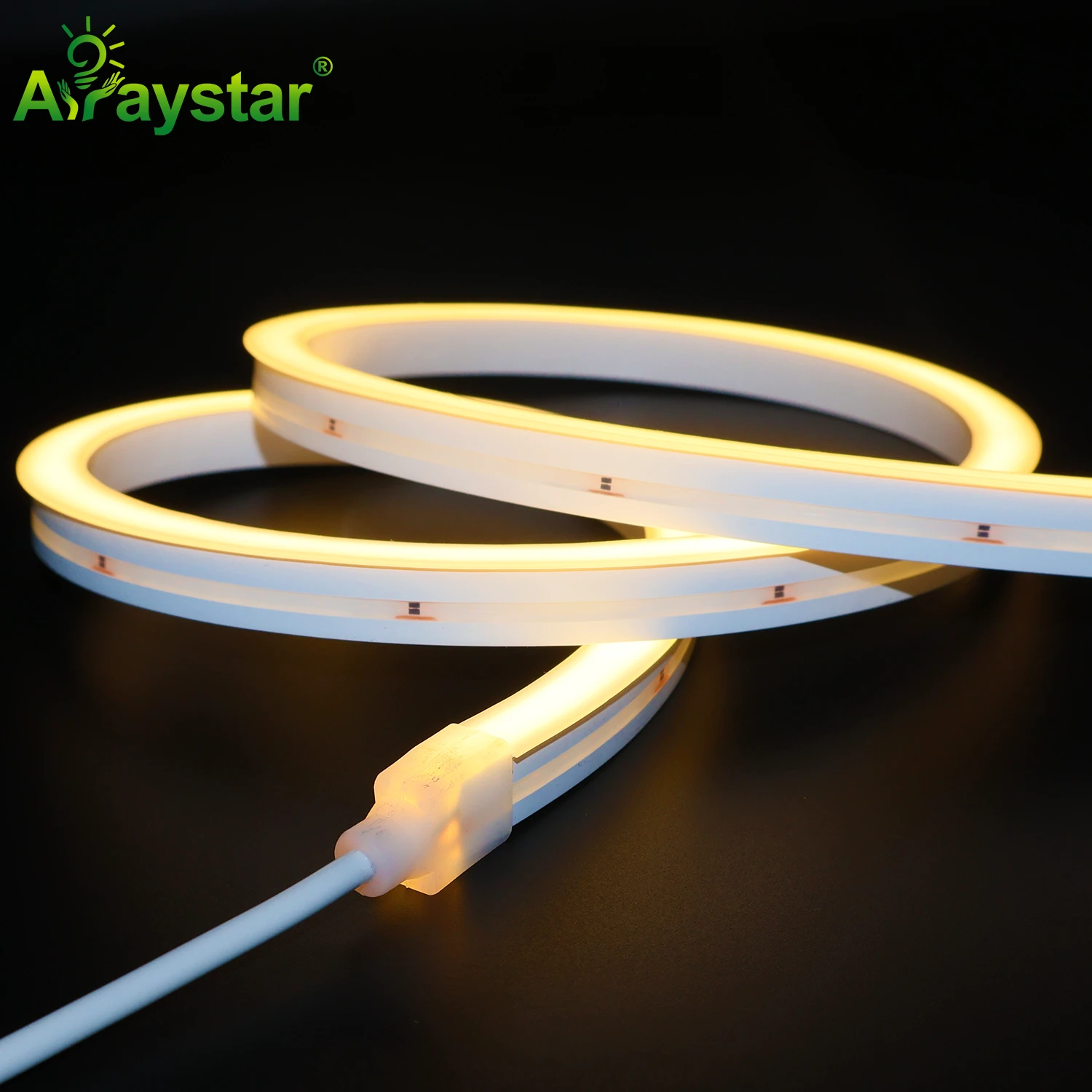
Horizontal Bending Neon Flex ART-NS1018
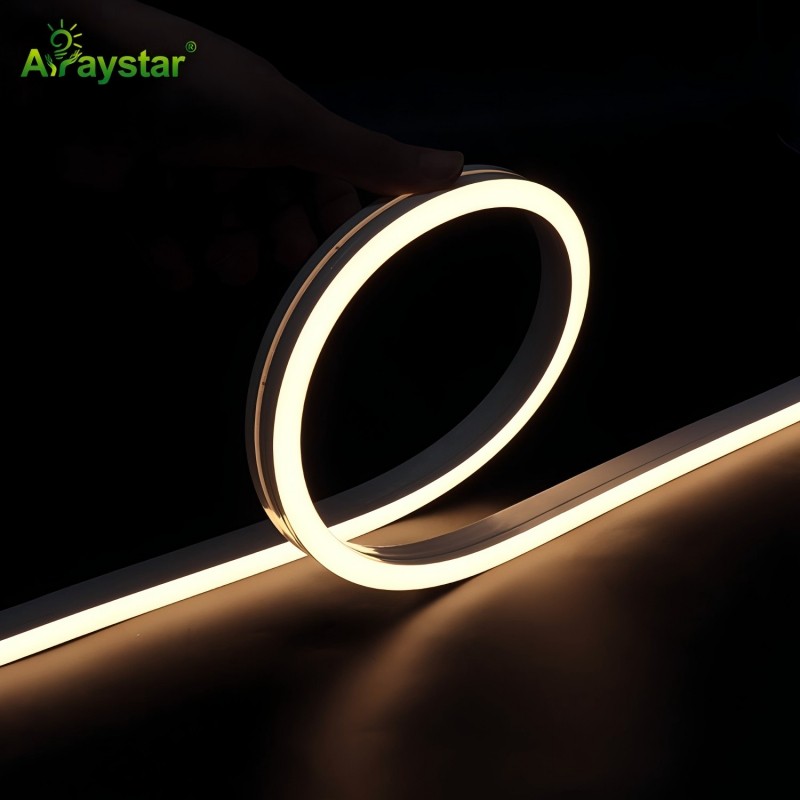
1018 Side Bend Neon Strip CCT/Color Voltage Power(W/M) LED Type LED Qty/m Cut Size Pixels/M IP Rating CRI Lumen(lm/M) ART-NS1018-120-X-12 1800K, 2700K, 3000K, 4000K, 6000K 12V DC 12 W/m 2835
340W Hexagon Garage Light Honeycomb LED Ceiling Lighting System for Car Detailing Workshop
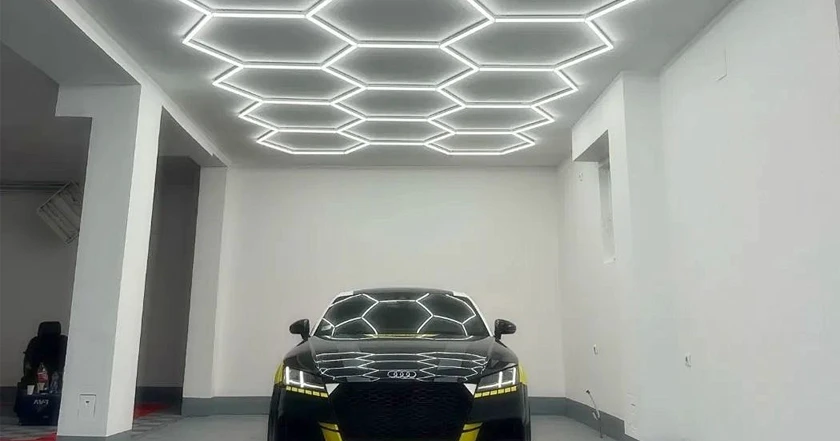
Model Voltage Power Efficiency CRI CCT ART-CL17-W-AW-220V110V AC90-260V 340W 120lm/W >90 6000K Size Color Material Installation Warranty Lifespan 1722×2478mm White PC + Aluminum Ceiling Mounted 3
Frequently Asked Questions
Q: Are side bend led neon strip dimmable?
A: Yes, side bend led neon strip support multiple dimming methods including 0-10V, PWM, TRIAC, DALI, and DMX512 when used with compatible dimmers and drivers. COB strips dim especially smoothly due to their uniform light output.
Q: What is the lifespan of side bend led neon strip?
A: Quality side bend led neon strip from Arraystar LED have a rated lifespan of 50,000+ hours (L70). Actual lifespan depends on operating temperature, current drive, and environmental conditions. We offer 3-year warranty on all products.
Q: Do you offer OEM/ODM services for side bend led neon strip?
A: Yes, Arraystar LED provides comprehensive OEM/ODM services including custom PCB design, specific LED binning, custom color temperatures, private labeling, and custom packaging. Our factory has 15+ years of experience serving clients in 80+ countries.
Q: Can side bend led neon strip be cut to custom lengths?
A: Yes, most side bend led neon strip can be cut at designated cut points (typically every 5cm or 10cm depending on LED density). Always cut at the marked copper pads and use proper connectors or soldering for reliable connections. COB strips offer mini-cut options with 2.5mm intervals.
Q: What power supply do I need for side bend led neon strip?
A: Choose a power supply matching your strip's voltage (12V/24V/48V) with wattage at least 20% higher than total strip consumption. For example, a 5m 14.4W/m strip needs at least 72W + 20% = 86.4W, so a 100W power supply is recommended.
Conclusion
Quality LED strips have a rated lifespan of 30,000-50,000 hours (L70/B50), meaning after 50,000 hours of use, 70% of LEDs still produce at least 70% of initial brightness. At 8 hours/day use, this equals 17 years; at 24 hours/day continuous use, 5.7 years. Actual lifespan depends on: LED chip quality, drive current, heat management, operating environment, and power supply quality. Budget strips may last only 10,000-20,000 hours, while premium strips can exceed 60,000 hours. Arraystar LED offers 15+ years of LED strip manufacturing experience with full OEM/ODM capabilities, CE/RoHS/ERP certification, and 3-year warranty. Contact our team for a free consultation and custom quote for your project.
Ready to start your project? Contact us today for expert guidance and competitive pricing.
About the Manufacturer
ArrayStar LED is a professional LED strip manufacturer in Shenzhen, China since 2010, serving 80+ countries. We support custom OEM/ODM projects (custom CCT, CRI, PCB, logo, packaging) and wholesale supply for distributors and contractors worldwide.