LED Strip for Pool & Underwater Lighting: Complete 2026 Guide
- 2026-09-18 15:35
- /
- Arraystar
Quick Answer
For pool and underwater lighting, use only IP68 fully sealed LED strips rated for continuous immersion — not IP65 splash-proof tape. Choose 12 V or 24 V SELV low voltage (never mains voltage in or near water), mount strips in silicone extrusions or sealed channels, and power them from an IP67 waterproof driver protected by an RCD/GFCI breaker. RGB / RGBW strips color the water beautifully; white COB strips light the steps safely.
📑 Table of Contents
- Why Pools Demand IP68, Not Ordinary Waterproof Strip
- Voltage, Safety and GFCI: The Non-Negotiable Rules
- IP68 vs IP67 vs IP65: Which Rating Does Your Pool Need?
- Where to Install: Coping, Steps, Infinity Edges and Spas
- Color, CRI and Control: White vs RGB
- Installation, Sealing and Driver Selection
- Recommended Products
- Frequently Asked Questions
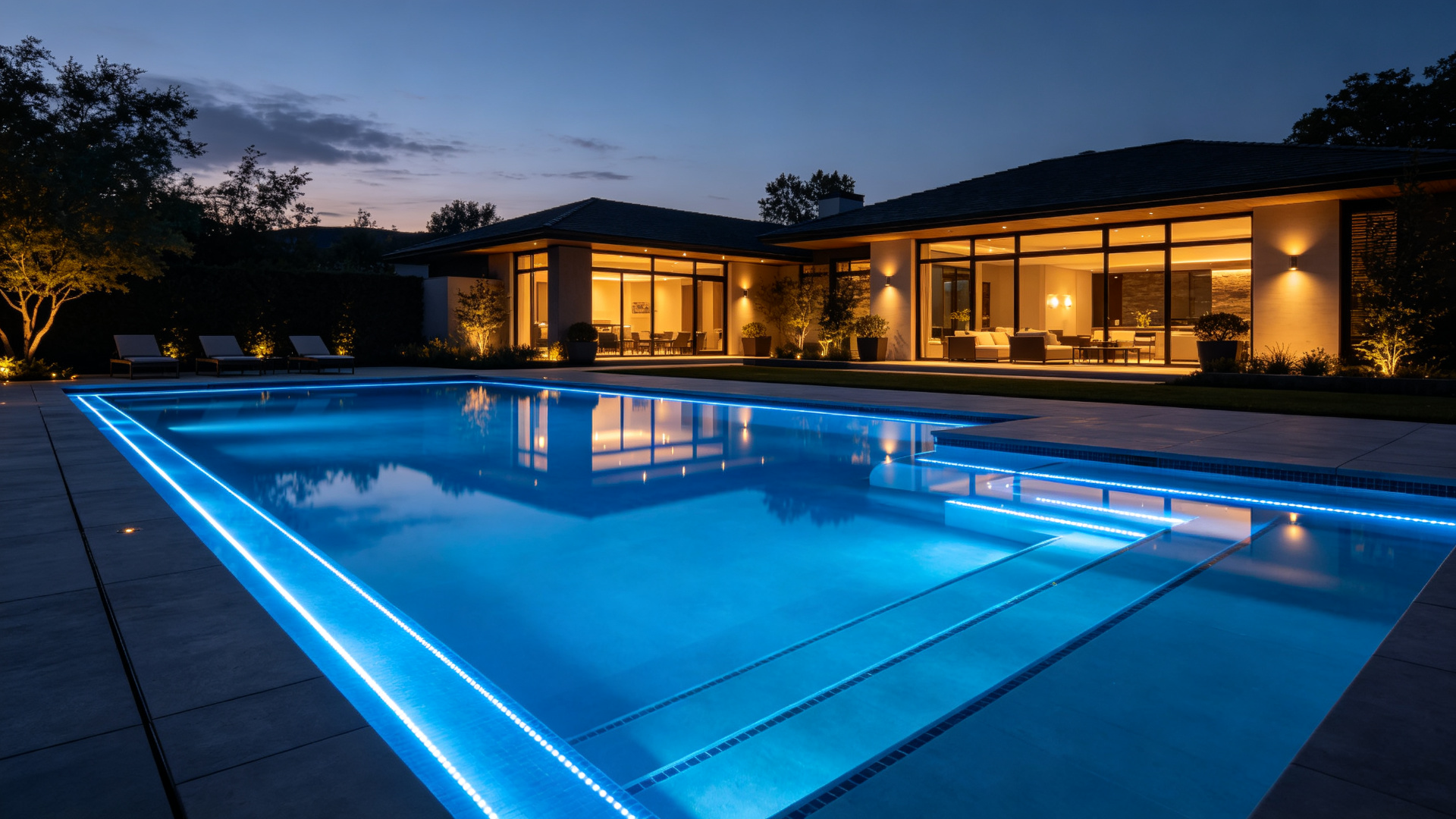
A single blue IP68 line tracing the pool waterline — uniform, even and fully submersible.
Why Pools Demand IP68, Not Ordinary Waterproof Strip
A pool is the most punishing environment an LED strip can face: continuous water immersion, chemical attack from chlorine and salt, and wet surroundings that make electrical safety critical. A standard IP65 silicone-sleeve strip resists splash, but it is not designed to sit under water night after night. Under constant pressure, water wicks along the PCB edge, attacks the solder joints and corrodes the copper traces — usually within a single season.
True underwater pool lighting requires IP68: the strip must be fully encapsulated — a continuous solid silicone or TPU extrusion with sealed ends and sealed, factory-molded joints. No air gap, no wick path. This is the same rating class used for fountains, water features and in-ground luminaire details. For a quick refresher on what each rating means, see our LED strip IP rating guide.
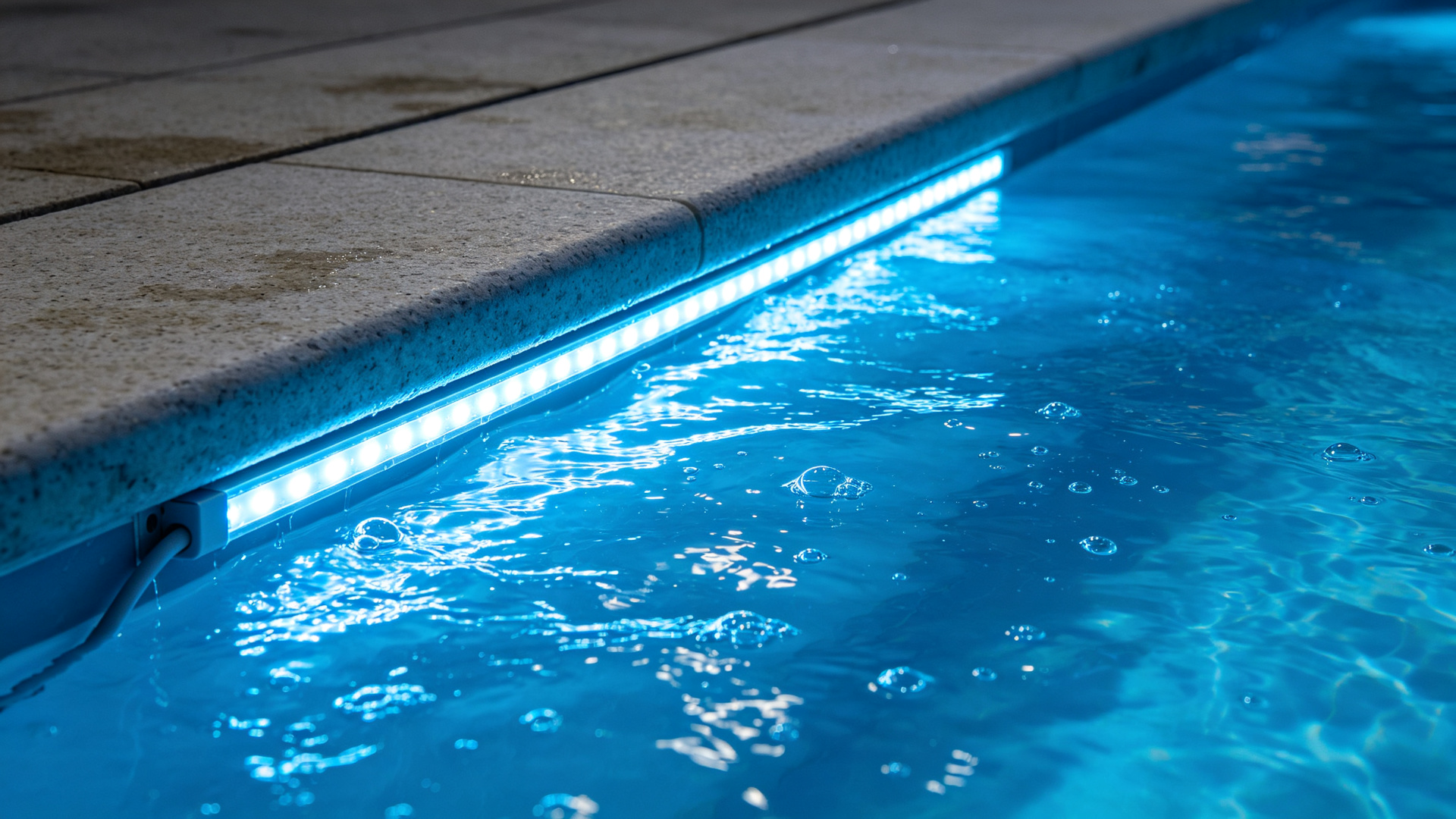
An IP68 solid-silicone extrusion under the coping edge — water cannot penetrate the encapsulated line.
Voltage, Safety and GFCI: The Non-Negotiable Rules
Around water, voltage is a safety issue, not just a convenience. Never run mains-voltage (110 V/220 V) strips in or around a pool basin. Use 12 V or 24 V DC SELV strips — separated extra-low voltage that cannot deliver a dangerous shock even if the insulation is nicked. The mains side lives in a sealed, above-water junction box, where a licensed electrician connects it to a waterproof driver protected by an RCD / GFCI breaker that cuts power within milliseconds of any fault.
Mount drivers and controllers above the high-water line, in IP67/IP68 boxes, and route supply cables through sealed waterproof glands. Every cable entry, every cut end and every splice must use the manufacturer’s matching IP68-rated connectors — an ordinary solder joint covered in heat-shrink is not a waterproof joint.
Golden safety rule: underwater = IP68 strip + 12/24 V SELV + IP67 waterproof driver + RCD/GFCI protection, all installed by a qualified electrician. Skip any one and you create a shock hazard.
IP68 vs IP67 vs IP65: Which Rating Does Your Pool Need?
| Location | Minimum IP | Recommended build |
|---|---|---|
| Pool steps, coping & waterline (wet, occasional immersion) | IP67 | Solid silicone extrusion, sealed ends, IP67 connectors |
| In-water / underwater, waterfall, spa seat | IP68 | Fully encapsulated TPU or solid silicone, factory-molded joints |
| Infinity edge, overflow channel (constant water contact) | IP68 | IP68 continuous extrusion, pressure-rated seals |
| Deck, coping top, around (splash only) | IP65 | Silicone sleeve or epoxy-coated, splash-proof |
| Pump room / equipment | IP54+ | Sealed junction box out of the wet zone |

An infinity edge sees constant water contact — this is an IP68, not IP65, application.
Where to Install: Coping, Steps, Infinity Edges and Spas
The most flattering pool lighting grazes the water rather than flooding it. Install the strip in the joint between the pool wall and coping, so the light spills down into the water as a luminous blue line. On steps, mount a strip under each tread nose so the riser glows — this both looks stunning and makes the steps safe after dark.
- Waterline / coping: strip in the wall-to-coping joint, pointing up into the water.
- Steps and entry: recess a strip under each tread — safety plus drama.
- Infinity edge: mount in the overflow channel, fully encapsulated.
- Spa / hot tub: RGB strip below the waterline for a color-changing glow through the bubbles.
- Wall washes: light the surrounding deck and planting, not just the water.
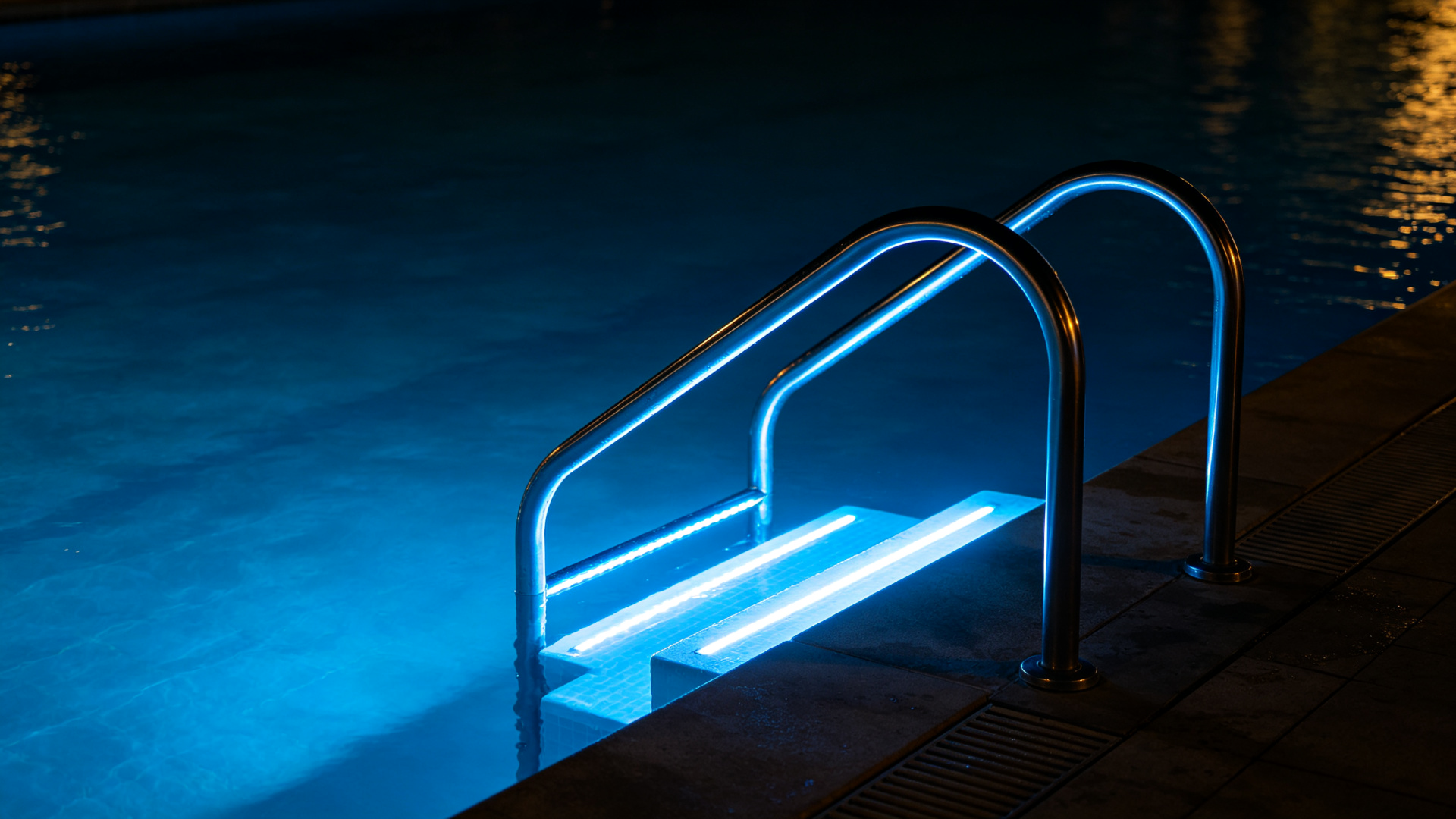
Step lighting doubles as safety guidance after dark.
Color, CRI and Control: White vs RGB
For safety-critical areas like steps, specify a fixed cool or warm white — predictable, high-output and simple. For mood and marketing, RGB or RGBW strips turn the whole pool blue, teal, purple or warm gold at the touch of a button. RGBW adds a true white channel so the water never looks pastel. Control options range from a simple RF remote to WiFi / Bluetooth apps that sync scenes and music. Because you are on 24 V DC, the full smart-control ecosystem is available — see the smart control comparison.
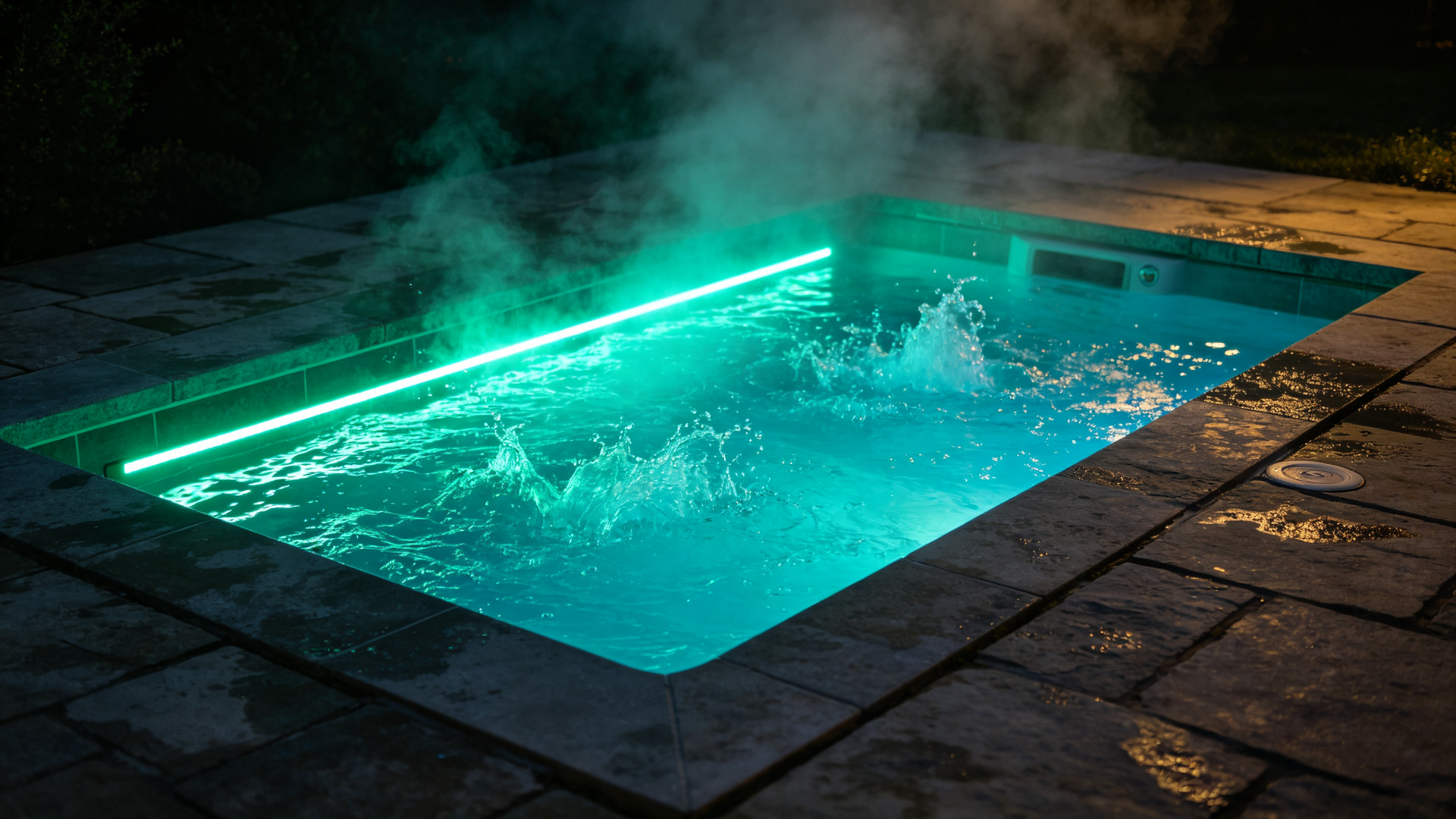
RGB underwater light turns the spa into a glowing centerpiece after dusk.
CRI matters less underwater than on land, but choose Ra 80 minimum and keep color temperature in mind: cool blue-white (~10000 K visual effect, or a blue phosphor chip) reads clean and modern, while warm white 2700–3000 K feels resort-like. Avoid the common mistake of mixing different color temperatures around the same pool — pick one and repeat it.
Installation, Sealing and Driver Selection
Underwater strips are usually ordered pre-cut to length with factory-sealed ends and a flying lead. If you must cut on site, follow the cut marks exactly and re-seal the end with the matching end cap and adhesive — an open cut end is the single most common failure point. Mounting is done with marine-grade double-sided tape or stainless clips into a recessed channel; never glue the strip directly to rough pool plaster.
Size the driver at at least 20–30% over the total strip wattage, and place it in an IP67 weatherproof box above the waterline. Feed long runs centrally to avoid voltage drop. For driver sizing math, see the LED strip power-supply calculator guide.
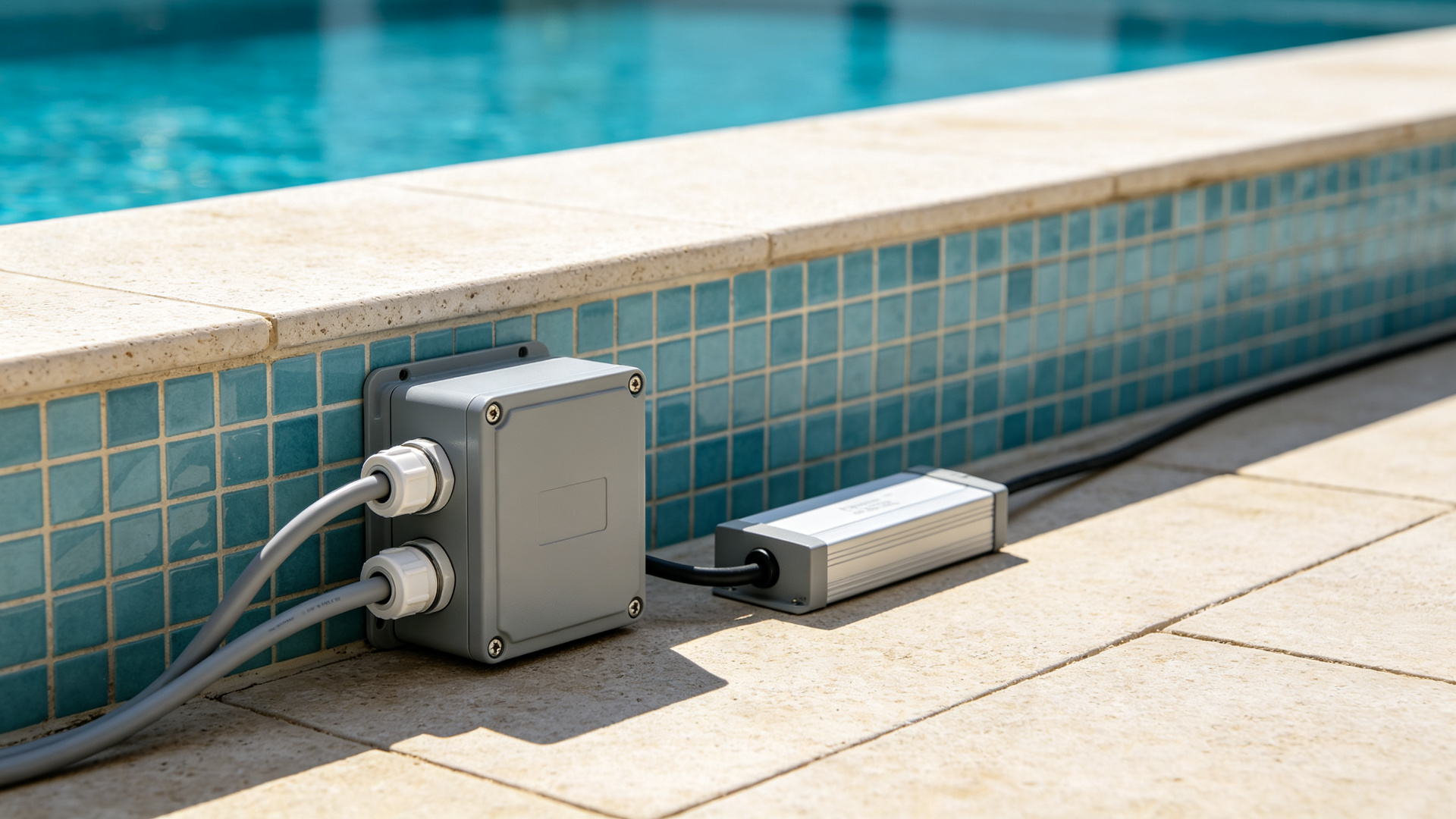
The driver lives in a sealed, above-water junction box on the mains side.
Recommended Products
Fully encapsulated IP68 TPU strip built for continuous immersion — the default for in-water pool, spa and fountain details.
IP68 Full Silicon Extrusion LED Neon Strip ART-NS0612-IP68
Solid silicone extrusion neon, fully IP68 sealed — a soft round glow for waterlines, steps and overflow channels.
IP68 Full Silicon Extrusion LED Neon Strip ART-NS1616-IP68
Larger 16×16 mm IP68 extrusion for high-output underwater and water-feature outlines.
IP68 Full Silicon Extrusion LED Neon Strip ART-NS1010-IP68
Square-profile IP68 silicone neon that seats cleanly in coping joints and step recesses.
Planning an outdoor LED strip project?
Get factory-direct pricing, free layout advice, samples and a custom quote within 24 hours.
Get a QuoteFrequently Asked Questions
Can any waterproof LED strip be used underwater in a pool?
No. Only IP68 strips rated for continuous immersion — fully encapsulated in solid silicone or TPU with sealed ends and joints — are safe underwater. IP65 and IP67 strips resist splash and temporary immersion but will wick water along the PCB and fail in a season. Always confirm the exact rating and that cut ends and connectors are also IP68.
What voltage should a pool LED strip run on?
Use 12 V or 24 V DC SELV (safe extra-low voltage) — never mains voltage in or around water. The mains-side driver must be above the water line, in an IP67 box, protected by an RCD/GFCI breaker, and installed by a qualified electrician.
Do pool LED strips need a special driver?
Yes. Use an IP67 waterproof LED driver sized at 20–30% above the total strip wattage, housed in a sealed junction box above the high-water line. Indoor drivers must never be exposed to pool humidity, spray or condensation.
Can RGB LED strips change the color of pool water?
Yes. RGB or RGBW underwater strips cast colored light through the water to create blue, teal, purple or warm effects, controlled by RF remote or WiFi/Bluetooth app. RGBW adds a true white channel so the effect never looks pastel and can also be used for safety lighting.