RGB Neon Flex Makes a Grotty White - Do I Need a White Channel?
- 2026-11-02 15:54
- /
- Arraystar LED
Mixing red, green and blue LEDs through a single diffuser never gives a clean white. It gives a slightly grey, slightly pinkish wash that looks cheap next to a real white. If your sign needs a believable warm white on the same run as colour, you need a dedicated white channel, not a clever controller.
The grotty white everyone complains about
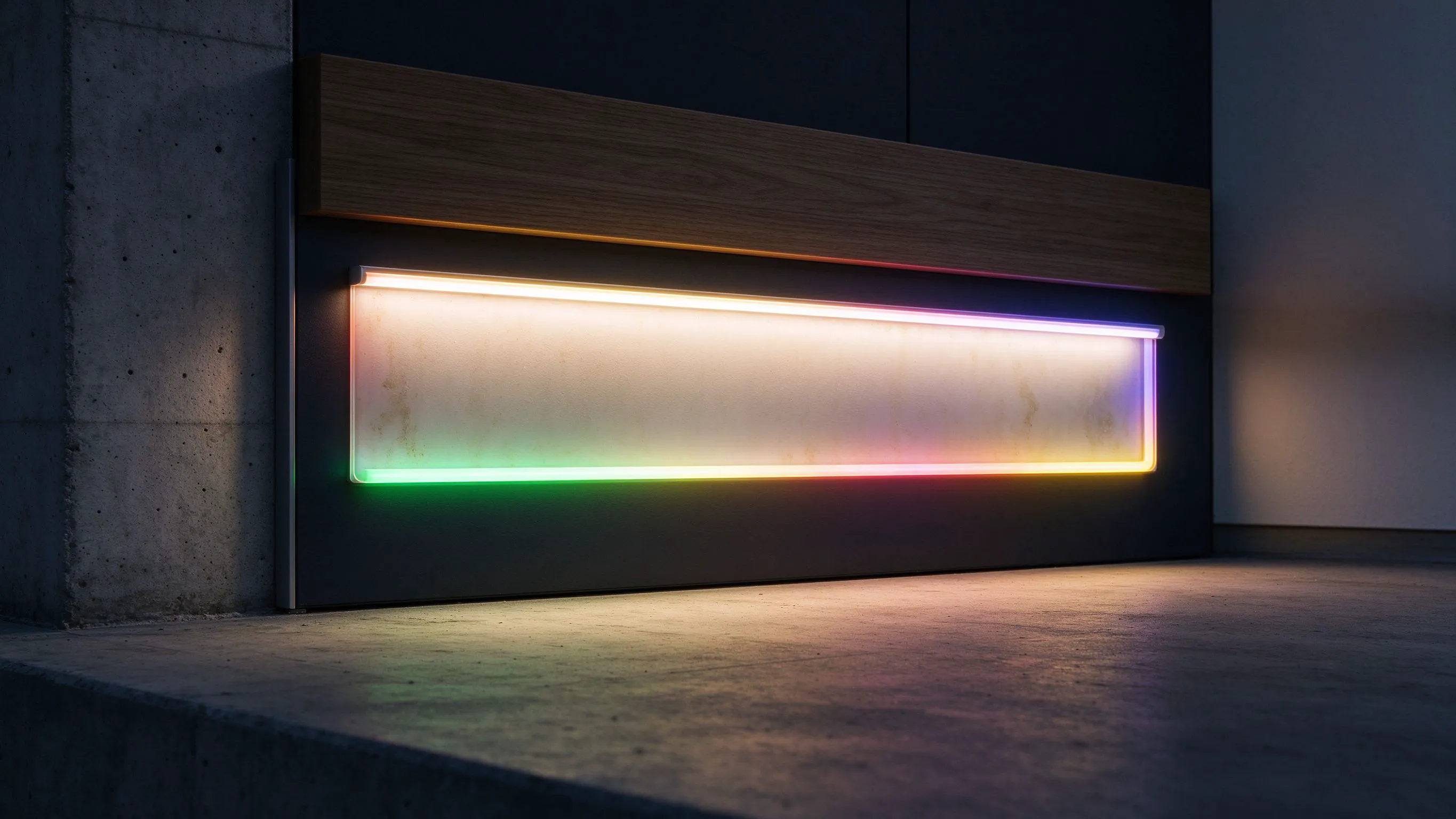
You pick RGB neon flex because you want a colour-changing sign, and the controller has a white button. You press it and the sign washes out a pale, slightly grey, slightly lavender light that nothing in the room reads as white. Your white walls look dingy, your skin looks off, and you start to wonder why the white LED panel on your ceiling looks so much cleaner.
It is not your controller. Mixing three die colours through a silicone diffuser is a compromise physics cannot fix. Red, green and blue peak at different wavelengths, and the human eye is very good at spotting the gaps in the spectrum. The result is a white with a colour cast that no amount of calibration fully removes.
Why RGB white never looks right
A real white LED has a blue chip pumping a yellow phosphor, which produces a broad, continuous spectrum your eye reads as white. An RGB mix only has three narrow spikes of red, green and blue. Outside those spikes there is no light, so pastel colours and skin tones look flat. The diffuser helps, but it cannot manufacture wavelengths that are not there.
- RGB mixes three narrow peaks; real white has a continuous spectrum.
- The eye notices the gaps, especially on skin and warm neutrals.
- No controller calibration fills in the missing wavelengths.
If white is a mode you actually use, RGBW or RGBCCT is the answer.
| System | White quality | Best for |
|---|---|---|
| RGB only | Greyish, colour-cast | Colour effects, not white |
| RGBW (adds white die) | Good, believable white | Signs that mix colour and white |
| RGBCCT (white tunable) | Excellent, warm to cool | Hospitality, living spaces |
What RGBW adds that RGB cannot
RGBW flex squeezes a dedicated white LED into the same diffuser alongside the RGB die. When you want white, the controller turns off the colour channels and runs the white die alone, which gives a clean, continuous-spectrum white. When you want colour, the colour die take over. You get both on the same run, with no visible seam.
The trade-off is density. Adding a white die means either fewer RGB die per metre or a wider diffuser to fit them. On a thin mini strip, the white channel is often a single warm white fixed at 3000 K. On a wider flex, you get RGB plus tunable white warm-to-cool.

Picking the right flex for a sign that needs white
I ask the client how often the sign actually shows white. If it is 90 percent colour effects and 10 percent white, a good RGBW is plenty. If the sign spends half its time in warm white behind a bar or shelf, I spec RGBCCT, which lets the white channel tune from 2700 K to 6500 K. On a sign that is always white, I skip RGB entirely and use a fixed-colour white flex.
Do not pay for RGBW if the sign never shows white.
| Use case | Pick | Why |
|---|---|---|
| Colour effects, rare white | RGBW | Good enough white for accent |
| Half warm white, half colour | RGBCCT | Tunable white matches decor |
| Always warm white | Fixed 2700 K flex | Cheapest, cleanest white |
Setting expectations after install
Even on RGBW, the white mode is a separate channel from the colour modes, so the brightness can differ slightly. I trim the white channel down on the controller so it matches the colour modes in perceived brightness. I also tell the client that the "white" on a fully RGB mode is still a mix and will look slightly off; the clean white lives on the dedicated white channel.
- Trim the white channel brightness to match the colour modes.
- Explain that mixed white is a special effect, not a real white.
- Photograph the white mode at night; the camera exposes the colour cast.
Recommended Products
Frequently Asked Questions
Why does my RGB neon flex make a bad white?
Because RGB mixes three narrow peaks of red, green and blue through the diffuser, and the eye sees the gaps in the spectrum. The result is a greyish, slightly pinkish or lavender white. No controller calibration fills in wavelengths that are not there. A dedicated white LED channel is the only way to get a clean white on the same run.
Do I need RGBW neon flex or is RGB enough?
It depends on how often you use white. If the sign is mostly colour effects and you only use white as a rare accent, RGBW is a cheap upgrade that gives a believable white when you need it. If the sign spends half its time in warm white, you want RGBCCT with tunable white. If it is always white, skip RGB and buy a fixed-colour flex.
What is the difference between RGBW and RGBCCT?
RGBW adds a single fixed white LED, usually around 4000 K, alongside the colour die. RGBCCT adds a tunable white channel that shifts from warm 2700 K to cool 6500 K on the controller. RGBW is simpler and cheaper; RGBCCT is worth it in hospitality and living spaces where the warmth of the white matters.
Can I fix muddy RGB white with a better controller?
No. A better controller gives smoother colour transitions and better timing, but it cannot add wavelengths the LEDs do not emit. The muddy white is a hardware limitation of mixing three narrow peaks through a diffuser. The only fix is running a dedicated white channel, which means RGBW or RGBCCT hardware.
Why does my skin look bad under RGB white?
Because the RGB white has gaps in the spectrum where skin tones reflect. A real white LED has a broad continuous spectrum, so skin looks natural. An RGB mix only has red, green and blue spikes, so faces look flat, grey or slightly orange. If the sign lights a mirror or a dressing area, use RGBW or a fixed warm white, not RGB.
Need help with your LED project?
Get factory-direct pricing, free samples and engineering support within 24 hours.
Email: info@arraystarled.com | Phone: +86-0755-2103-6746 | WhatsApp: 0086 1581 8514 077
Need to size your power supply? Use our LED Strip Power Calculator to find the right driver in seconds.