COB Strip Inside a Sealed Wooden Cabinet: Heat Buildup That Kills It
- 2026-11-02 15:54
- /
- Arraystar LED
A closed wooden cabinet turns a dense COB run into an oven, and the strip cooks itself from the inside out. I measure the internal temperature, vent the top and bottom, and derate the strip wattage by about 30 percent for any enclosed cavity. A sealed cabinet without ventilation kills LEDs within two seasons.
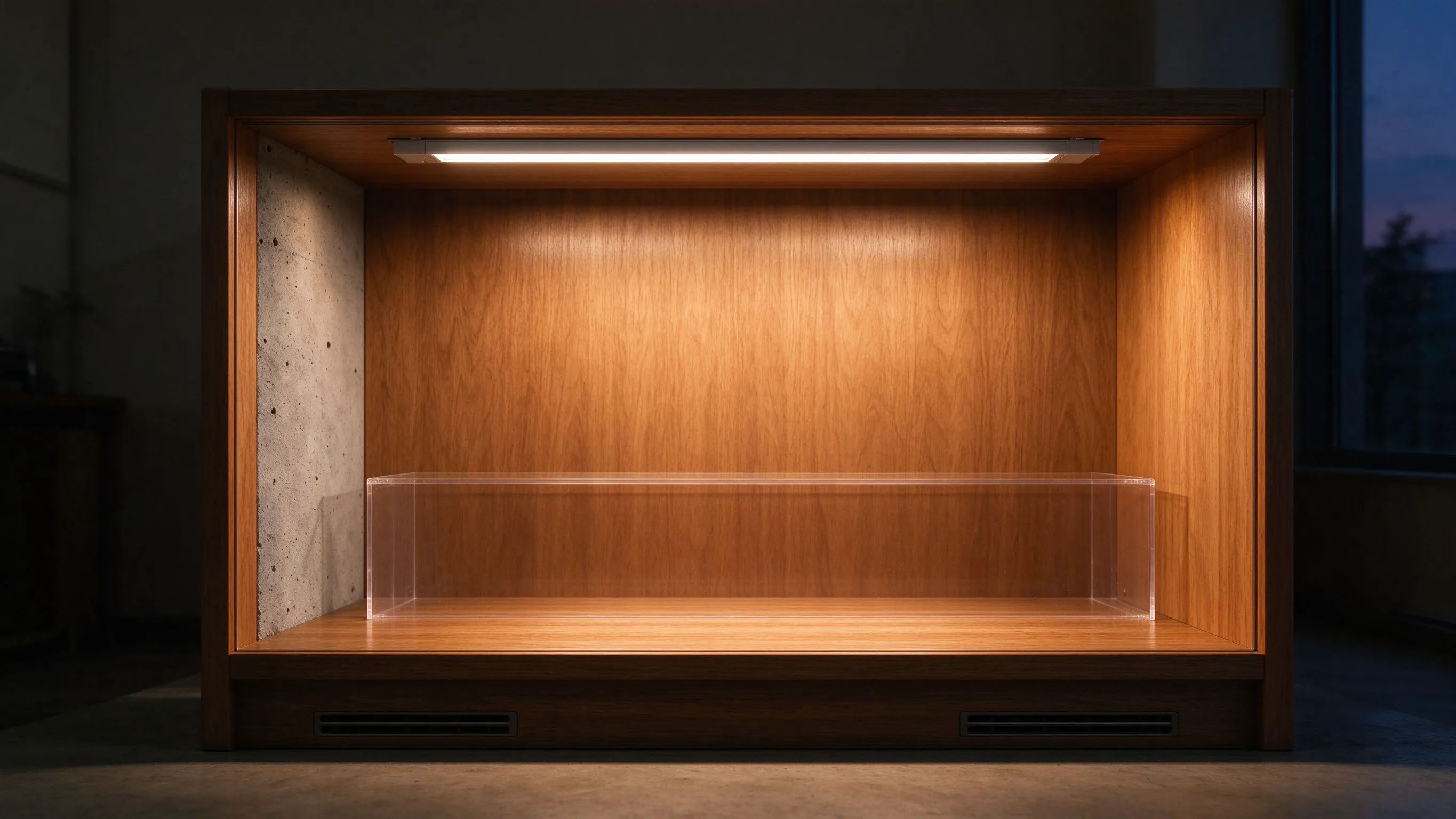
The cabinet that looked fine on day one
A client built a sealed oak display cabinet, lined the interior with a dense COB strip, and the glow was perfect on install day. Six months later the strip went yellow at the top of the cabinet, and a year later the top third was dead. The cabinet was airtight, and the strip had been cooking at 70 C inside a warm wooden box for hundreds of hours.
Wood is a good insulator. It does not breathe like aluminium extrusion, and it does not dissipate heat. A COB strip running at 12 to 18 watts per metre dumps that heat into a sealed 20 litre cavity with nowhere to go. The junction temperature climbs until the LEDs shift colour and then fail.
Why a sealed cabinet traps heat
LED strips are 80 to 85 percent inefficient, meaning 80 percent of the wattage becomes heat rather than light. In an aluminium extrusion, that heat spreads along the metal and radiates to the room. In a sealed wooden box, the heat stays in the air inside the cabinet, warms the walls, and the strip sits in its own hot exhaust. Junction temperatures can run 25 to 40 degrees above ambient.
What kills the strip in order
- Junction temperature over 60 C accelerates lumen depreciation.
- Over 80 C, phosphor degrades and white output shifts yellow.
- Over 100 C, the flex PCB substrate delaminates and copper tracks lift.
Measuring the cavity temperature
Before I add ventilation, I measure. I run the strip at full brightness for two hours with the cabinet door closed, then tape a thermocouple near the strip and at the top of the cavity. If the air near the strip is over 50 C, the strip is running too hot. A handheld IR gun works for a rough check, but a thermocouple taped to the PCB pad is the honest number.
- Run the cabinet closed at full brightness for two hours.
- Measure air temperature 20 mm from the strip; under 45 C is safe.
- Measure at the top of the cavity, where hot air pools; under 50 C is safe.
- If the top reads over 60 C, stop and vent before another season.
Venting and derating that work
I never rely on ventilation alone. I combine three moves: passive vents at the top and bottom of the cabinet, a lower-wattage strip, and a derated driver. Passive vents let hot air escape at the top and draw cool air in at the bottom, which keeps the cavity within 10 degrees of ambient. Derating the strip wattage means it produces less heat to begin with.
Venting plus derating beats any single fix.
| Cavity setup | Air near strip | Strip life expectation | Action |
|---|---|---|---|
| Sealed, 18 W/m strip | 70-85 C | Under 10,000 hours | Must vent and derate |
| Vented, 18 W/m strip | 45-55 C | 25,000 hours | Monitor |
| Vented, 10 W/m strip | 35-45 C | 50,000 hours | Good |
| Aluminium extrusion | 30-40 C | 50,000+ hours | Reference |
Choosing the right strip for an enclosed cabinet
For any enclosed or semi-enclosed wooden cabinet, I spec a lower-wattage COB strip rather than the brightest reel I have. A 10 W per metre free-cut slim strip gives plenty of light for display lighting and produces barely half the heat of an 18 W per metre reel. I also drive it at 24 V rather than pushing 220 V into a sealed cavity, because low voltage means simpler driver isolation and lower heat from the driver itself.
- Pick a strip rated at 10 to 12 W per metre for enclosed cabinets, not 18 W.
- Mount the strip on a thin aluminium backing tape if the cabinet will let you, to spread heat.
- Add 10 mm top and bottom vents covered with a plastic mesh so insects do not move in.
- Mount the driver outside the cabinet, not inside; the driver itself dumps heat.

Recommended Products
Frequently Asked Questions
How hot is too hot for a COB strip in a cabinet?
Keep the air within 20 mm of the strip under 50 C. The PCB pad itself can run 15 to 20 degrees above that, so aim for a junction under 70 C. If the top of the cavity reads 60 C or more on a hot day, the strip is already cooking and you will see yellowing within a year.
Do I really need vents in a sealed wooden cabinet?
Yes. A sealed cavity has no way to shed the heat the strip produces. Fit 10 mm vents at the top where hot air collects and matching vents at the bottom where cool air draws in. Cover them with a fine plastic mesh so dust and insects do not move in. Natural convection does the rest.
Should I use a lower wattage strip or a lower current driver?
Both, but start with a lower wattage strip. A 10 W per metre strip produces half the heat of an 18 W per metre strip at the source. Once you have that, you can trim the driver current by another 10 percent if the cabinet still runs hot. Underrunning a hot strip buys life, but it is not a substitute for venting.
Can I put the driver inside the cabinet?
No. The driver itself dumps 10 to 20 percent of its output as heat, and that heat goes straight into the sealed cavity. Mount the driver outside the cabinet, in a vented void, or on the back of the cabinet where it can radiate to the room. A remote driver cable is cheap insurance.
Why does the strip go yellow at the top of the cabinet first?
Hot air rises, so the top of the cavity runs hottest. The phosphor on the LEDs at the top ages faster and shifts toward yellow before the lower sections do. That gradient is the signature of heat buildup, not a binning fault. Vent the top and derate the strip and the gradient goes away.
Need help with your LED project?
Get factory-direct pricing, free samples and engineering support within 24 hours.
Email: info@arraystarled.com | Phone: +86-0755-2103-6746 | WhatsApp: 0086 1581 8514 077
Need to size your power supply? Use our LED Strip Power Calculator to find the right driver in seconds.