COB Strip vs Smart Bulbs for Cove Lighting: Cost vs Effect
- 2026-10-28 10:03
- /
- Arraystar LED
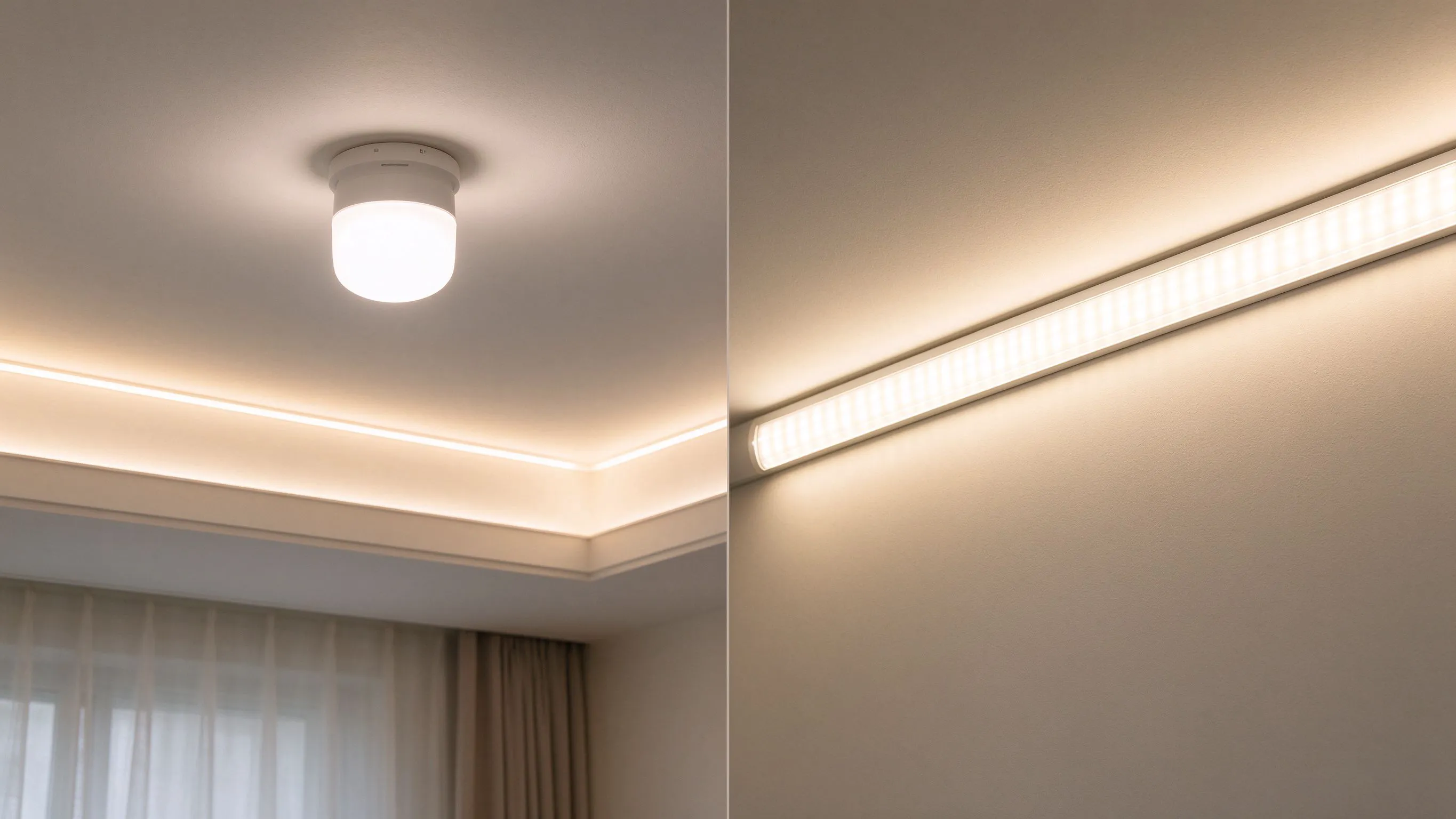
Smart bulbs are cheap and tunable but they show as dots in a cove. A COB strip gives one continuous wash, costs more up front, and is the right call when the cove is long and viewed from below.
What each method actually is
A smart-bulb cove is just a row of lampholders or plug sockets tucked behind the lip, each holding a Wi-Fi or Bluetooth bulb. You can use whatever screw or bayonet fitting the site already has, and the bulb can be swapped in ten seconds.
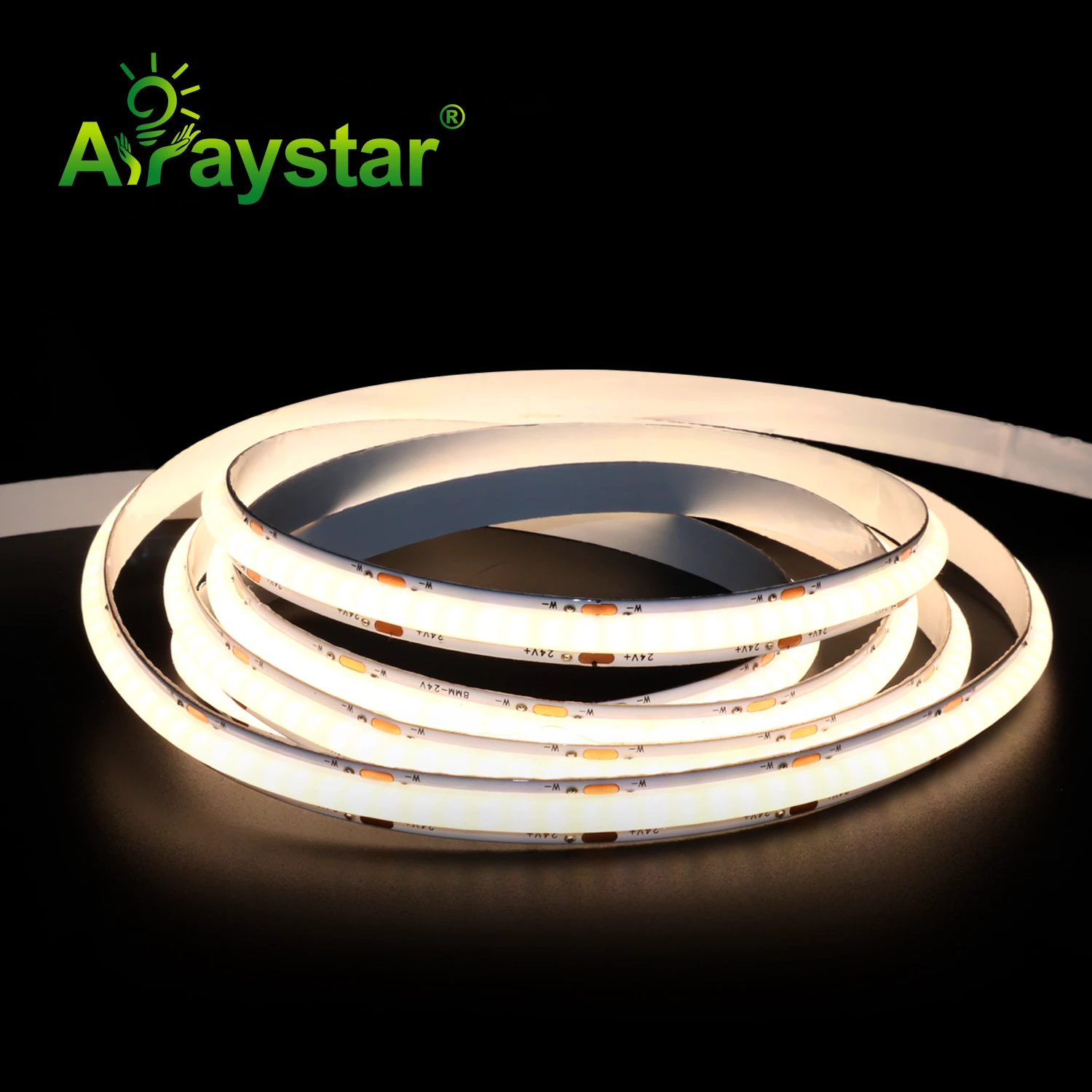
A COB strip cove is a continuous PCB with chips bonded directly to a flexible substrate, usually 5 to 10 mm wide and supplied in 5 m reels. The diffuser on the COB package blends the chips so closely that the strip reads as a single line of light.
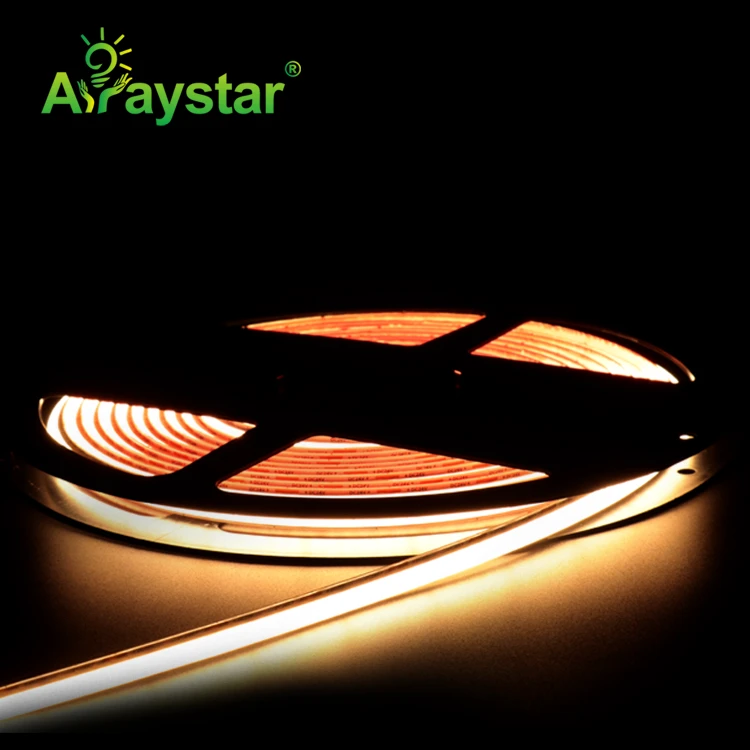
The first job on site is to decide which problem the cove is solving. If it is architectural wash on a ceiling that people will stare at, COB wins on appearance. If it is accent lighting inside a shelf or display where the cove is barely visible, bulbs are cheaper and faster.
Install cost and labour
Priced in labour, bulbs are fast. You fit a row of lampholders, run a fused circuit, screw the bulbs in, and pair them on the phone. On a 6 m room that is maybe two hours of electrician time plus the bulbs themselves. There is no driver to size, no aluminium channel to cut, and no soldering.
A COB cove needs more kit per metre: the strip itself, a 24 V constant-voltage driver, aluminium extrusion or a flat clean surface, corner connectors or solder joints at every turn, and a diffuser cover if the channel has one. On the same 6 m room you are looking at four to six hours, plus the driver budget.
Indicative BOM split, not a quote.
| Cost line | Smart-bulb cove (6 m) | COB strip cove (6 m) |
|---|---|---|
| Point-source hardware | 8 to 12 bulbs at 3 to 8 pounds each | 6 m of COB reel |
| Driver / power | Plugs or existing circuit | 24 V driver, 10 to 15 W per m loaded |
| Aluminium channel | Not needed | 6 m of extrusion plus diffuser |
| Electrician labour | about 2 hours | about 4 to 6 hours |
| Reachable for lamp changes | Yes | No, strip is permanent |
The hidden cost with bulbs is return visits. A bulb that fails six months later means someone has to climb in the cove, find the right fitting, and re-pair it. A sealed COB install rarely needs a visit unless the driver dies.
Light quality and uniformity
This is where COB pulls away. A COB strip at 240 to 560 LEDs per metre, mounted in a deep cove with a setback of 100 to 150 mm, throws a smooth gradient onto the ceiling.
Colour is the other gap. Most consumer smart bulbs are 2700 K to 6500 K tunable but hold tolerance loosely, so adjacent bulbs can drift to visibly different whites.
Beam shape matters too. A smart bulb floods in every direction and half the light goes backward into the cove void, wasted. A COB strip in an aluminium channel with a frosted diffuser directs the output upward at a controlled angle, so nearly all of it reaches the ceiling.
Control and flexibility
Smart bulbs win on control, no question. Each bulb is its own controller: you can dim to 1%, tune from warm to cool, set scenes, and group rooms from a phone. Retrofitting one bulb changes a single zone without touching the wiring. If the client wants disco colours at a party, a bulb strip does it out of the box.
A COB strip is one continuous load. To dim it you need a leading-edge or 0 to 10 V or DALI driver, and to tune colour you need a tunable-white CCT strip plus a CCT controller.
- Pick smart bulbs when the cove is short, visible but not the main feature, and the client wants app control per lamp.
- Pick COB when the cove runs 4 m or longer, when the ceiling wash must be seamless, or when colour consistency across a room matters.
- Pick hybrid: COB for the main perimeter wash, one or two smart lamps on a separate circuit for accent zones the client wants to fiddle with.
Common mistakes and install checks
The most common bulb mistake is spacing them too wide. Builders space a lampholder every 500 mm because that is cheap, then wonder why the cove looks like a string of pearls. Drop to 200 to 250 mm centres for anything that is actually on show.
The most common COB mistake is mounting the strip too close to the lip. If the strip sits flush with the cove opening you see the diffuser line from the floor, and on a 24 V run longer than 5 m you get a visible brightness drop at the far end because of voltage sag.
- Measure the cove depth before choosing strip width: a 5 mm strip fits a 10 mm lip; a 10 mm strip needs a deeper channel.
- Check the driver load: total strip watts plus 20% margin, never run a driver above 80% nameplate.
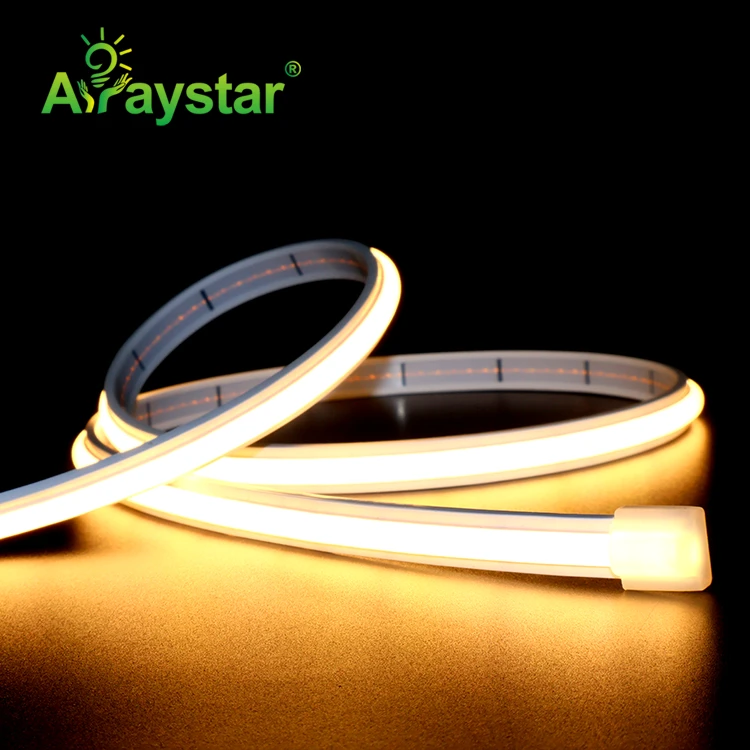
- On damp coves above bathrooms or outdoor eaves, move to an IP67 silicone-extruded strip and keep the driver inside the room.
- Run a 1 m test length on the bench before installing the whole reel to confirm colour and cut points.
Walk the finished install from the room normal viewing positions, not from a ladder. Most defects show up from the sofa, not from the cove lip.
Recommended Products
Frequently Asked Questions
Can I mix smart bulbs and COB strip in the same cove?
Yes, but keep them on separate circuits. A bulb and a COB strip have different beam shapes and colour binning, so adjacent runs will not match at the edges. Use COB for the long perimeter and bulbs only on short accent sections.
How long can a 24 V COB cove run before voltage sag shows?
At 24 V, brightness starts to drop visibly after about 5 m on a single feed. Above 5 m, feed both ends or split the run into 5 m segments with a parallel feed per segment. Keep total loop current under 4 A per feed.
Do smart bulbs look bad in every cove?
No. In a shallow cove where the light is bounced and the lip is high, bulbs spaced at 200 to 250 mm read acceptably. They look bad when spaced at 500 mm or wider, or when the cove is low enough that you see the lamp directly.
What IP rating do I need for a bathroom cove?
The strip itself should be IP65 or higher if it is within 2.5 m of a bath or shower and likely to see splash or steam. IP67 silicone-extruded strips are the safe choice. Keep the 24 V driver outside the bathroom zone.
Is a COB cove more expensive than bulbs overall?
Up front yes, by roughly 30 to 50% once you add the driver, channel and labour. Over a five-year life it often works out cheaper because there are no bulb replacements and no call-outs for failed lamps.
Need help with your LED project?
Get factory-direct pricing, free samples and engineering support within 24 hours.
Email: info@arraystarled.com | Phone: +86-0755-2103-6746 | WhatsApp: 0086 1581 8514 077
Need to size your power supply? Use our LED Strip Power Calculator to find the right driver in seconds.